
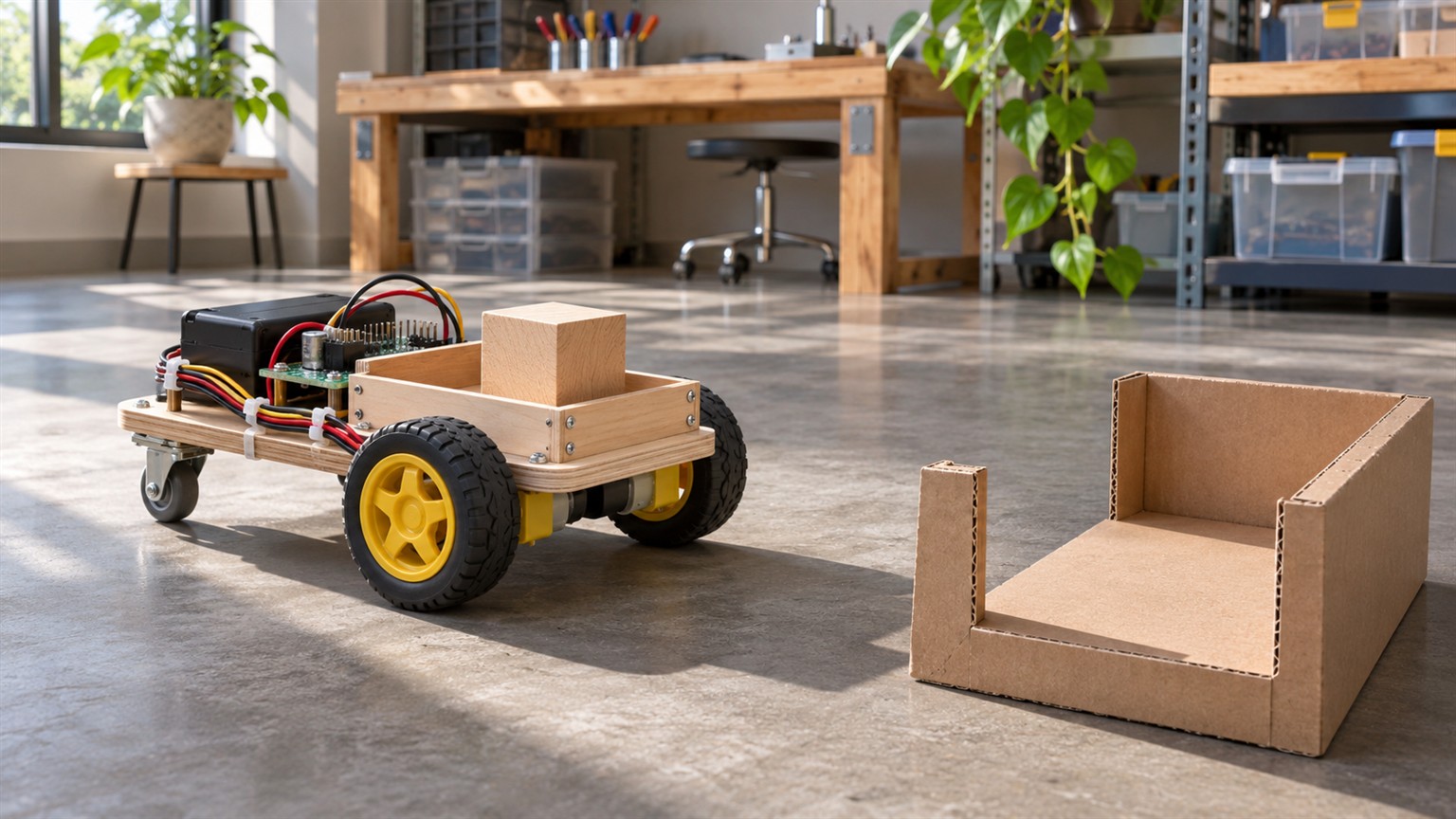
Give Each Robot One Building Problem to Solve
A robot project becomes easier to learn from when its challenge is specific. Driving straight tests wheel alignment and motor control; lifting a foam cube tests leverage and grip; returning to a marked station tests sensing and recovery. You do not need to solve all of those problems in one elaborate machine. These twenty-five project briefs range from simple mobile platforms to small mechanisms that sense or respond to their surroundings. Each identifies a skill worth practicing and a test that can show whether the design improved. They are starting points for choosing documented hardware and planning a build, rather than universal wiring instructions. Keep the mechanisms small, light, and supervised, begin with low speeds and harmless objects, and provide a reachable way to remove motor power before testing movement.
A: No. A small cart, gripper, or controlled mechanism can teach robotics through movement and feedback.
A: Choose an improvement that addresses a measured problem; simple contact or distance sensing may be sufficient.
A: Alignment, traction, loading, and differences between motors can produce unequal real movement.
A: They measure rotation; slipping and wheel geometry affect the relationship to ground distance.
A: Stay within documented hardware limits and use lightweight harmless test pieces rather than deliberately overloading it.
A: A reachable way to remove motor power and a clear stopped behavior suited to the supervised setup.
A: After checking sensor readings, calibration, mounting, and the chassis on the actual course.
A: A sensor-driven movement lets you study input changes, bounded response, filtering, and delay without vehicle navigation.
A: Their patterns help distinguish a repeatable design problem from a one-off demonstration error.
A: A bounded search with a defined stopped outcome is easier to supervise and evaluate.
Build a Testable Platform Before Adding Features
A basic robot needs a stable mechanical structure, suitable actuators, a controller, and a power arrangement that matches the actual hardware. Select motor drivers using the motors’ electrical requirements, including relevant peak or stall-current demands, rather than only the current seen during easy rotation. Follow the driver’s instructions for supplies and ground connections. Motor power should not be drawn casually from a microcontroller’s logic output. Adafruit’s Motor Shield documentation illustrates why power arrangements and starting loads deserve attention, although its wiring applies to the specific shield described there.
Make your first test area bounded, level, and clear of stairs, pets, loose clothing, and valuable objects. Lift drive wheels clear of the surface for initial direction checks, keeping fingers away from the mechanisms. Disconnect power before changing a linkage or removing a jam. Write a visible success criterion, such as reaching a cardboard dock repeatedly at low speed without striking it. Record failures as observations about the design, including battery condition and floor surface, so later changes answer a real problem instead of merely making the machine more complicated.
Three Mobile Foundations
1. Two-wheel straight-line rover
Build a differential-drive chassis with two driven wheels and an appropriate support caster. Ask it to travel a short marked distance at low speed, then compare its sideways drift over several runs. Check wheel attachment, alignment, and traction before compensating entirely in software. This platform teaches you that equal motor commands do not guarantee equal real movement.
2. Bumper-and-reverse explorer
Add a mechanical bumper that tells the rover to stop, back away, and turn after gentle contact with a soft barrier. Design the bumper so it cannot trap the switch in the pressed position. Test contacts near both corners as well as directly in front. A useful recovery sequence must return the bumper to a state where another obstacle can be detected.
3. Tether-controlled inspection cart
Steer a slow cart through a short course using a wired hand controller. Support the cable so it does not become the main steering force or wrap around a wheel. Include a control state that stops movement when released. The project makes chassis handling, cable routing, and command mapping visible before you add the uncertainty of a wireless connection.
Four Robots That Read Their Route
4. Simple line follower
Place reflectance sensors on a rover and follow a high-contrast line on a flat course. Calibrate against the actual light and dark surfaces before tuning turns. Begin with gentle curves and inspect what happens when the line disappears. Pololu’s 3pi guide provides a documented example of line-following principles, but sensor spacing and control settings must suit your own platform.
5. Wall-distance follower
Use an appropriate distance sensor to maintain a modest gap from a straight wall. Start with a long, plain surface and low speed so you can distinguish measurement noise from steering corrections. Test the point where the wall ends and define a safe response. A robot that follows one surface well should not continue indefinitely when that reference disappears.
6. Light-seeking rover
Compare two light sensors and turn toward a controlled light source in a supervised indoor area. Shield or position the sensors to create a useful directional difference. Repeat the test under different room lighting before trusting the response. The build teaches comparative sensing and also exposes why a simple light gradient is not a general-purpose navigation system.
7. Color-marker stop station
Have a rover stop when a compatible downward sensor recognizes a designated floor marker. Measure the marker under the lighting and sensor height used during travel. Test approach speed and braking distance instead of moving the sensor over the mark by hand alone. A successful station combines recognition with enough stopping room for the moving chassis.
Six Mechanisms for Handling Harmless Objects
8. Foam-cube gripper
Build a small two-finger gripper for identical foam cubes before attempting irregular household objects. Compare finger padding, opening width, and grip force at the same object position. Keep fingers away during powered movement and use low-force hardware. The important result is a repeatable gentle grasp that does not rely on crushing the object to keep it from slipping.
9. Short-reach pick-and-place arm
Move a lightweight block between two nearby marked positions using a supported arm. Keep the reach short and the load within the mechanism’s documented limits. Test whether the base moves or the arm sags as the block changes position. This teaches how leverage and structural stiffness affect performance even when the commanded servo angles remain identical.
10. Token sorting gate
Guide large, consistent tokens down a shallow chute and divert them using a small controlled gate. Detect one token at a time before adding classification. Try variations in spacing and surface friction to reveal jams. You will learn that reliable feeding often matters more than the sophistication of the sensor making the sorting decision.
11. Miniature conveyor transfer
Move lightweight foam pieces along a small guarded conveyor and stop them at a sensing point. Begin with generous spacing between pieces and keep nip points inaccessible. Compare belt alignment and object slip before changing the stopping program. A conveyor makes the relationship between continuous motion, detection delay, and final position easy to observe.
12. Suction pickup experiment
Use a documented small vacuum system to lift a smooth, very light test piece over a tray. Check compatibility among pump, tubing, valve, and pickup cup before assembly. Compare a clean smooth surface with one that leaks air at the seal. Do not suspend valuables; the experiment should make a failed seal harmless and easy to understand.
13. Sliding-block dispenser
Push one oversized wooden block from a short magazine using a slow mechanism with guarded travel. Start with only two blocks so you can inspect how the next one settles. Explore clearances and friction before increasing capacity. The skill is controlling a repeatable mechanical handoff, including what should happen if the block does not move as expected.
Five Robots That Communicate Through Movement
14. Desk creature with moving ears
Create a small stationary character whose lightweight ears change position after a button press. Separate the ear mechanism from its decorative shell during early tests. Check that the covering does not restrict travel or rub the servo linkage. The build combines simple mechanical motion with expression while keeping navigation and object handling outside the initial scope.
15. Slow kinetic flower
Open lightweight paper petals through a protected linkage and close them gently on command. Build one petal first to investigate the hinge and connecting rod. Expand only after that movement remains free throughout its range. Repeated cycles reveal rubbing and fatigue that a single attractive opening does not show, especially where paper meets a rigid actuator.
16. Gesture-following puppet
Use a documented orientation or distance sensor to control one puppet movement at a time. Begin with head rotation instead of trying to map every limb. Add a neutral region so tiny sensor changes do not produce constant twitching. You will practice translating a human gesture into bounded mechanical output that feels intentional and remains within safe travel limits.
17. Robotic rhythm tapper
Move a light padded beater against a small practice surface using a suitable mechanism. Keep the impact gentle and support the surface so it cannot shift into the linkage. Compare the sound and timing at different stroke lengths. The project teaches repeatable contact and shows why increasing speed can create mechanical bounce rather than better musical accuracy.
18. Direction-pointing messenger
Rotate a visible lightweight arrow toward one of several physical destinations after a deliberate input. Establish a known starting position and check that the mechanism cannot wind its cable around the shaft. Test every destination from every other destination. This is a compact robotics interface where clear motion and dependable state matter more than a decorative screen.
Seven Experiments in Repeatability and Recovery
19. Pen-holding drawing rover
Attach a lightly sprung pen holder to a small rover and draw simple shapes on a protected paper area. Compare the same square drawn several times before designing elaborate patterns. Watch whether pen friction changes wheel traction or twists the chassis. The drawing records movement errors, giving you a visible basis for adjusting geometry and control.
20. Two-axis tabletop plotter
Move a pen across a small bounded workspace using a documented plotter mechanism and drivers. Establish travel limits before running a drawing, and provide safe clearance from moving belts or screws. Start with separate straight lines on each axis. Comparing their lengths and squareness reveals alignment issues that a complex image might conceal.
21. Encoder distance challenge
Add wheel encoders and ask a rover to stop after a measured number of counts. Compare its actual travel on different surfaces with the same command. Encoders measure rotation, which can differ from ground distance when wheels slip. Use the mismatch to investigate traction and loading instead of assuming the added sensor has removed every source of error.
22. Slow docking cart
Approach a broad cardboard docking station using suitable short-range sensing or contact detection. Design a final low-speed phase and a defined stop state. Test approaches that begin slightly off-center rather than arranging every run perfectly. A successful dock tolerates small alignment errors without forcing the chassis into the station or continuing to drive after contact.
23. Lost-line recovery trial
Extend a working line follower with a bounded search when its route disappears. Define a maximum search time and a stopped state if the route is not found. Test gaps separately from the edge of the course. This project makes recovery an explicit behavior instead of allowing the robot to interpret missing information as permission to keep moving.
24. Small walking linkage demonstrator
Build one low-force walking linkage on a stationary support before attempting a free-walking robot. Rotate it slowly and inspect clearances through the full cycle. Compare how foot shape and linkage geometry affect the motion traced on paper. This is a mechanical learning project first; extra legs should follow a useful understanding of one complete movement.
25. Sensor-guided pan platform
Rotate a light sensor platform slowly toward a controlled target while keeping its base stationary. Limit its angular range and route wiring so repeated movement cannot stretch it. Compare raw sensor changes with a filtered response and inspect the delay introduced. The experiment introduces feedback tuning through a small mechanism whose behavior is easier to isolate than a moving vehicle.
Keep the Result You Can Explain and Repeat
Choose one project, one physical test, and one improvement to investigate next. Keep photographs, wiring references, part variants, software versions, and the conditions used for successful trials together. A short record of several imperfect runs teaches more than a single edited demonstration. Before expanding the robot, check that it can start safely, stop deliberately, and handle the missing or awkward input its task is likely to encounter. Preserve the simple working version while testing additions, and let repeated evidence decide whether the extra sensor or mechanism has improved the machine. The strongest beginner robot is often the modest one whose movement and limits you understand well enough to reproduce.