
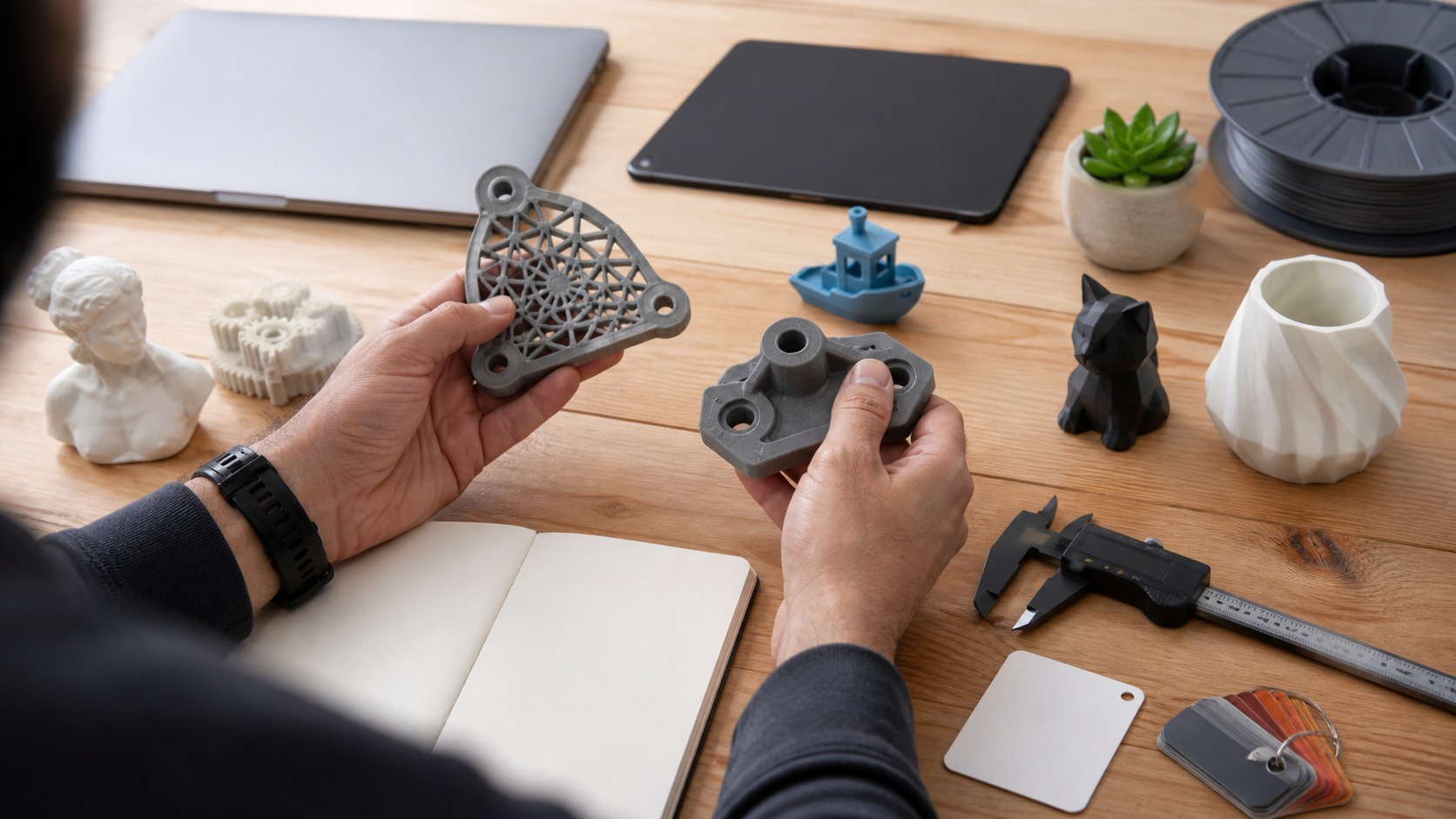
A Good Free STL Is More Than A Download Button
The best free STL file sites for 3D printing projects are useful only when the files are printable, legal to use, clearly described, and suited to your machine and material. A model can look impressive in a thumbnail and still be oversized, unsupported, non-manifold, badly oriented, poorly licensed, or designed for a printer very different from yours. Smart makers evaluate free files the way they evaluate materials: by checking the source, the geometry, the comments, the license, the purpose, and the likely cleanup before sending plastic through the nozzle.
A: Start with the smallest test that proves one real part of the project.
A: Enough to know the goal, material limits, tool setup, and first safety check.
A: No. It should be clear, testable, and easy to revise.
A: Early failures usually come from poor first layers, wrong temperatures, weak orientation, wet filament, bad supports, and unfinished cleanup.
A: Match the material to load, use, finish, cost, repair, and available tools.
A: Scale after a small test works repeatedly and the cost still makes sense.
A: Save measurements, settings, suppliers, photos, failures, and changes.
A: Rework drops, fit improves, safety is clearer, and results repeat more often.
A: Avoid hiding weak structure, unsafe setup, or unclear decisions under a nice finish.
A: It solves the intended job and teaches a better next build.
Start With Purpose, Not Search Results
Free STL sites can make a beginner feel rich in options and poor in decisions. Before searching, name what the print needs to do. Is it decorative, functional, educational, repair-focused, a jig, an enclosure, a toy, a display piece, or a replacement part? The answer changes what quality means.
A decorative model can survive small dimensional issues. A replacement latch, bracket, spacer, or hinge cannot. Use the purpose to decide how carefully to inspect the file.
Look For Evidence Of Real Prints
Actual print photos are valuable because they show how the model behaves outside rendering software. They reveal support scars, bridging problems, surface texture, scale, and whether the design has been handled by a real printer. A perfect render may hide a model that has never been tested.
Community makes free STL sites useful. Comments, remixes, and photos often reveal the missing instructions. Read them before slicing, especially for large or functional prints.
Understand Licensing Before Making Promises
Free does not mean free for every use. Some models allow personal printing only. Some require attribution. Some allow remixing but not selling. Some forbid redistribution. If you plan to sell prints, post photos publicly, teach from the file, or modify the model, read the license first.
Keep a note of the license with any file you might reuse. Months later, the source page may change or disappear, and you still need to know what terms applied.
Preview The File In Your Slicer
A slicer preview is where many downloaded-file problems appear. Check size, orientation, thin walls, unsupported islands, support volume, print time, and material use. Rotate the model if needed, but remember that orientation changes strength, surface quality, and support scars.
Do not wait until the print is halfway done to discover that a tiny floating feature starts in midair. Preview is part of responsible downloading.
Functional Prints Need Extra Skepticism
Functional models need more than a clever shape. They need correct dimensions, appropriate material, load-aware orientation, enough wall thickness, and a plan for heat, wear, and fasteners. A downloaded bracket may look strong but split along layer lines if printed in the wrong direction.
For critical or safety-related parts, free files deserve conservative testing. Print small sections, measure clearances, and avoid using unknown designs where failure can damage property or hurt someone.
Editable Source Files Are Gold
An STL is often hard to edit cleanly because it is only a mesh surface. If the creator provides STEP, Fusion, OpenSCAD, Blender, or other source files, save them. Editable files make it easier to move holes, change text-free geometry, adjust clearances, or adapt the model to your printer.
This is especially useful for jigs and repair parts. The first downloaded version is rarely perfect for your exact object.
Compare Several Models Before Printing
The first search result is not always the best model. Compare wall thickness, part orientation, comments, update date, photos, license, and whether the design appears overcomplicated. Sometimes a simpler model prints better and lasts longer than a flashy one.
If several models solve the same problem, choose the one with the clearest evidence. Printability should beat novelty when the project needs to work.
Keep A Responsible File Library
A personal STL library should not become a junk drawer. Store files by project or category, include source links, preserve license notes, and keep modified versions separate from originals. Rename copies so their purpose is clear without opening every file.
Good file hygiene prevents accidental misuse and makes reprinting easier. The best free STL site is much more useful when your own library stays understandable.
Let Free Files Teach Design Judgment
Downloaded models are not only shortcuts. They are lessons in geometry, tolerances, supports, orientation, and user assumptions. Study why a model prints cleanly or fails badly. Compare several creators’ solutions to the same problem.
Over time, this turns browsing into education. You become less dependent on finding the perfect STL because you learn what a good printable design looks like.
Know The Difference Between Inspiration And Production
Some free STL sites are wonderful for inspiration but inconsistent for production. A beautiful model may be designed for display, not strength. A clever repair part may work only for one version of an object. A decorative sculpt may require supports and cleanup that exceed a beginner’s patience.
Decide whether you are browsing ideas, learning techniques, or choosing a file to print today. Each mode needs different standards.
Check The Creator’s Pattern
A creator with multiple tested models, clear photos, update notes, and useful comments is often a safer source than an anonymous upload with one dramatic render. Look for signs that the designer prints their own work and responds to problems. That pattern builds trust.
This does not mean new creators should be ignored. It means the file deserves more inspection when there is less evidence behind it.
Evaluate Files For Your Printer Size
Many free models assume a build volume, nozzle size, or support strategy that may not match your printer. Large models might need splitting. Tiny details may disappear with a larger nozzle. Tall parts may wobble. Bed contact may be too small for reliable adhesion.
Before downloading a whole collection, test one representative part. If the file family uses the same clearances and wall style throughout, the first print can tell you a lot.
Respect Attribution As Part Of Maker Culture
Free model sharing works because creators choose to release their work. Attribution is a small but important way to keep that culture healthy. Even when a project is personal, saving the creator name and source link helps later if you share photos or remix the design.
Good attribution habits also protect you from confusion. When several files in a folder look similar, source notes explain which one came from where and what license it carried.
Use Remixes As Quality Signals
Remixes can show that a model has an active life. They may fix tolerances, add versions, improve print orientation, or adapt the part for different hardware. A model with thoughtful remixes may be more useful than one with only likes.
Read remix notes carefully. A remix might solve a problem you have, or it might introduce assumptions that do not fit your project.
Print One File Before Trusting A Collection
Collections can encourage over-downloading. Print one small model first, evaluate surface, fit, support, and scale, then decide whether the creator’s style suits your needs. This saves time and keeps your file library cleaner.
A good free STL workflow is selective. The goal is not to own every possible model; it is to find files that help real projects succeed.
Build A Shortlist Instead Of A Huge Bookmark Folder
A small shortlist of trusted sources is more useful than dozens of forgotten bookmarks. Keep sites or creators that provide tested files, clear licensing, useful categories, and models that match your printer. Revisit that shortlist before wandering through endless search results.
This habit makes free-file searching faster and safer. You begin with sources that have already earned some trust, then expand only when the project needs something new.
Test License Understanding With Real Scenarios
Before using a file publicly, ask practical questions. Can I post photos of the print? Can I give the print away? Can I sell it at a market? Can I modify it? Can I share my modified file? The license should answer those questions before the model becomes part of a public project.
If the answer is unclear, choose a different file or ask the creator. Ambiguity is not a strong foundation for selling or redistributing work.
Use Downloaded Files To Learn Design Patterns
Good free STL files can teach wall thickness, chamfer use, support reduction, snap fits, screw bosses, tolerances, and print orientation. Study models that print well. Look at how the designer avoided impossible overhangs or protected fragile details.
Bad files teach too. A failed download can show why thin posts break, why unsupported features sag, or why decorative models are not automatically functional.
Keep The Human Creator In The Loop
Behind most free STL files is a person who spent time designing, testing, and sharing. Respecting licenses, giving attribution, posting helpful feedback, and sharing successful print settings makes the ecosystem better. Makers benefit when sharing remains healthy.
The best free STL sites are not just warehouses. They are communities of practical knowledge, and your habits help decide how useful those communities remain.
Choose Sites By Project Category
The best source for tabletop miniatures may not be the best source for repair brackets, educational models, mechanical parts, or decorative home objects. Each community rewards different design habits. Choose sources that match the kind of print you need, not only the largest library.
Functional projects benefit from sites and creators that document dimensions, hardware, and revisions. Decorative projects may benefit more from sculpt quality and print photos.
Make A First-Print Checklist
Before printing a free STL, check license, source, size, orientation, support needs, wall thickness, estimated time, and material. This simple checklist prevents most careless downloads from reaching the printer. It also makes the decision less emotional when a model looks exciting but prints poorly.
A checklist is not bureaucracy. It is a way to protect filament, time, and respect for the creator’s terms.
Use Free Files As Starting Points
Sometimes the best free STL is not the final answer but a starting point. It may prove a mechanism, show a mounting idea, or provide a shape that inspires a custom version. That is useful as long as the license allows the way you use it.
Makers grow when they move from collecting files to understanding them. A downloaded model can become a lesson in designing your own.
Prefer Files That Explain Assembly
Multi-part models should show how pieces relate physically, even when no readable instructions are printed into the image. Exploded photos, hardware notes, and clear part names reduce guesswork. A free file that saves assembly confusion is often better than a prettier model with no context.
Let The Print Queue Stay Intentional
A full download folder can create an endless print queue with no purpose. Choose the next print because it serves a project, teaches a technique, or tests a useful design pattern. Intentional printing makes free STL sites feel like a tool rather than a distraction.
Avoid Printing Unknown Critical Parts
A free STL for a decorative object is low risk. A free STL for a load-bearing, hot, electrical, or safety-related part deserves much more caution. Use judgment before trusting downloaded geometry with real consequences.


