The Big Idea Behind Mechanical Design
Mechanical design begins with a simple question: how can an idea become something that moves, lifts, rotates, presses, cuts, carries, protects, or performs useful work? Every modern machine, from a compact coffee grinder to a massive construction crane, starts as a design challenge. Engineers must understand what the machine needs to do, how much force it must handle, how long it should last, and how people will interact with it. This makes mechanical design both technical and creative, because the best machines are not just strong or efficient; they are purposeful. At its heart, mechanical design is the art and science of turning function into form. A designer studies forces, motion, materials, friction, heat, vibration, and manufacturing limits before a product ever reaches a factory floor. Each bolt, bracket, bearing, shaft, spring, and housing has a reason to exist. When those parts work together smoothly, a machine feels almost inevitable, as if it could not have been built any other way.
A: It is the process of creating parts, mechanisms, and systems that perform useful physical work.
A: Start with forces, materials, measurements, CAD, fasteners, and simple mechanisms.
A: Yes, CAD is one of the main tools used to model, refine, and document modern machines.
A: Tolerances make sure parts fit together correctly despite normal manufacturing variation.
A: Strong load paths, good materials, proper lubrication, simple assembly, and tested components improve reliability.
A: They compare strength, weight, cost, wear resistance, temperature limits, and manufacturing needs.
A: Prototyping tests ideas, exposes weaknesses, and helps designers improve the machine before production.
A: It means shaping parts so they can be produced efficiently, accurately, and affordably.
A: Common causes include overload, fatigue, wear, corrosion, heat, vibration, poor alignment, and weak joints.
A: Engineers define the problem, explore concepts, model parts, analyze loads, prototype, test, refine, and prepare for manufacturing.
Starting with the Problem
Every successful machine starts with a clearly defined problem. Before engineers open CAD software or choose materials, they must understand the job the machine is supposed to perform. Is it lifting heavy loads, transferring power, reducing human effort, automating a repeated motion, or protecting delicate parts from harsh conditions? Without a strong problem definition, the design can drift into complexity, cost overruns, and unnecessary features.
This stage often includes performance goals, space limits, safety needs, budget expectations, and user requirements. A machine designed for a factory floor has different priorities than one designed for a home workshop, medical device, drone, or race car. Good mechanical design starts by narrowing the target. The clearer the mission, the easier it becomes to make smart decisions later.
Turning Concepts into Mechanical Solutions
Once the problem is understood, designers begin exploring possible solutions. This is where rough sketches, simple models, and early calculations become powerful tools. Engineers may compare several approaches, such as using gears instead of belts, hydraulic power instead of electric motors, or aluminum instead of steel. At this stage, speed matters because ideas need room to develop before the team commits to one direction. Concept design is also where creativity plays a major role. Many machines can solve the same problem in different ways, but not all solutions are equally practical. The best concept usually balances performance, simplicity, manufacturability, cost, reliability, and maintenance. A clever design is not always the most complicated one. Often, the smartest machine is the one that does the job with fewer parts, cleaner motion, and fewer opportunities for failure.
Understanding Forces and Loads
Mechanical design depends on understanding how forces move through a machine. Every component must handle loads created by weight, motion, pressure, impact, torque, vibration, or repeated use. If a part is too weak, it may bend, crack, wear out, or fail completely. If it is overbuilt, the machine may become too heavy, expensive, or inefficient.
Engineers study load paths to see how forces travel from one part to another. In a simple lifting device, the load might move through a hook, cable, pulley, shaft, bearing, frame, and mounting point. Each part must be strong enough for its role, but the entire system must also work as a connected structure. This is why mechanical design is never just about individual parts. It is about relationships between parts.
Materials: Choosing What Machines Are Made Of
Material selection can make or break a mechanical design. Steel offers strength and toughness, aluminum provides lighter weight, plastics can reduce cost and corrosion, rubber can absorb vibration, and composites can deliver high strength with low mass. Each material brings advantages, limitations, and manufacturing requirements. Choosing the right one means understanding what the part must survive. A gear, for example, may need hardness and wear resistance. A machine frame may need stiffness and weldability. A handle may need comfort, grip, and impact resistance. Material choices also affect cost, sustainability, maintenance, and production speed. The best material is not always the strongest or most expensive. It is the one that fits the function, environment, lifespan, and manufacturing method.
Motion, Mechanisms, and Moving Parts
Machines come alive through motion. Mechanical designers use mechanisms to guide, convert, control, or amplify movement. A motor may spin continuously, but the machine may need linear motion, oscillation, clamping action, indexing, or controlled rotation. Linkages, cams, gears, pulleys, belts, chains, bearings, springs, and shafts help shape that motion into useful work.
Designing moving parts requires careful attention to clearance, friction, alignment, lubrication, and wear. A mechanism that works perfectly in theory may fail if parts bind, flex, overheat, or collect debris. Smooth motion is often the result of many small design decisions. The placement of a bearing, the shape of a slot, the angle of a linkage, or the finish on a shaft can change how the entire machine feels and performs.
Designing for Strength and Durability
Strength is one of the most visible goals in mechanical design, but durability is just as important. A part may survive one heavy load but fail after thousands or millions of repeated cycles. This is known as fatigue, and it is one of the most important concerns in machines that rotate, vibrate, flex, or carry changing loads. Designers must think not only about maximum force, but also about repeated stress over time. Durability also depends on environment. Machines may face heat, cold, moisture, dust, chemicals, corrosion, sunlight, impact, or continuous operation. A machine built for outdoor construction work needs different protection than one used in a clean laboratory. Strong design means anticipating real-world abuse and building enough resilience into the system without wasting material or cost.
Tolerances and Precision
Tolerances define how much variation is acceptable in a manufactured part. No part is made perfectly, so engineers must specify how close each dimension needs to be. Tight tolerances can improve precision, but they also increase manufacturing cost. Loose tolerances may reduce cost, but they can cause poor fit, vibration, leakage, misalignment, or performance problems.
Good mechanical design uses precision where it matters most. A bearing seat may need a carefully controlled diameter, while a cosmetic cover may allow more variation. The goal is not to make everything as exact as possible. The goal is to control the right features so the machine assembles correctly, runs smoothly, and performs reliably.
CAD and Digital Modeling
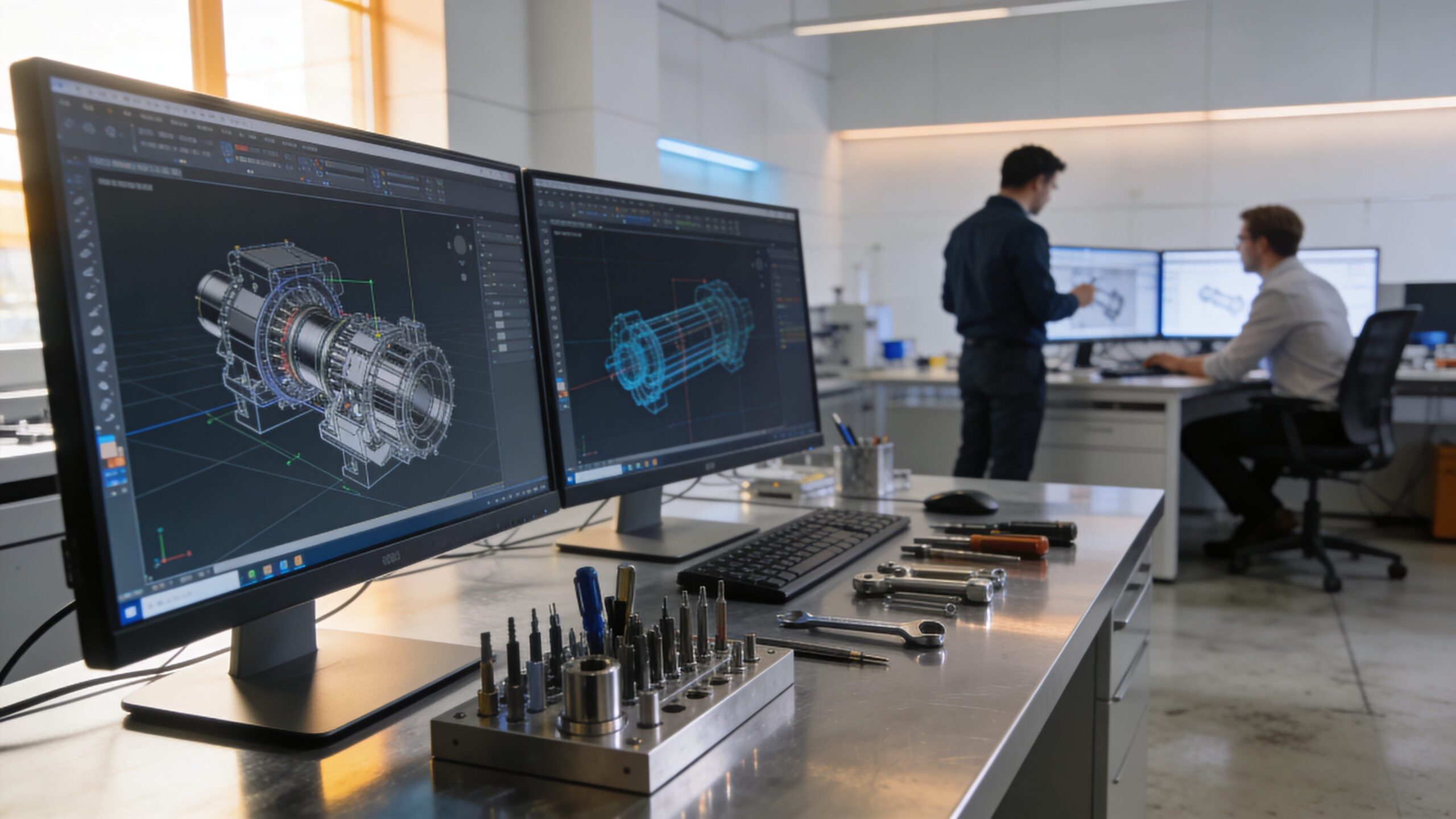
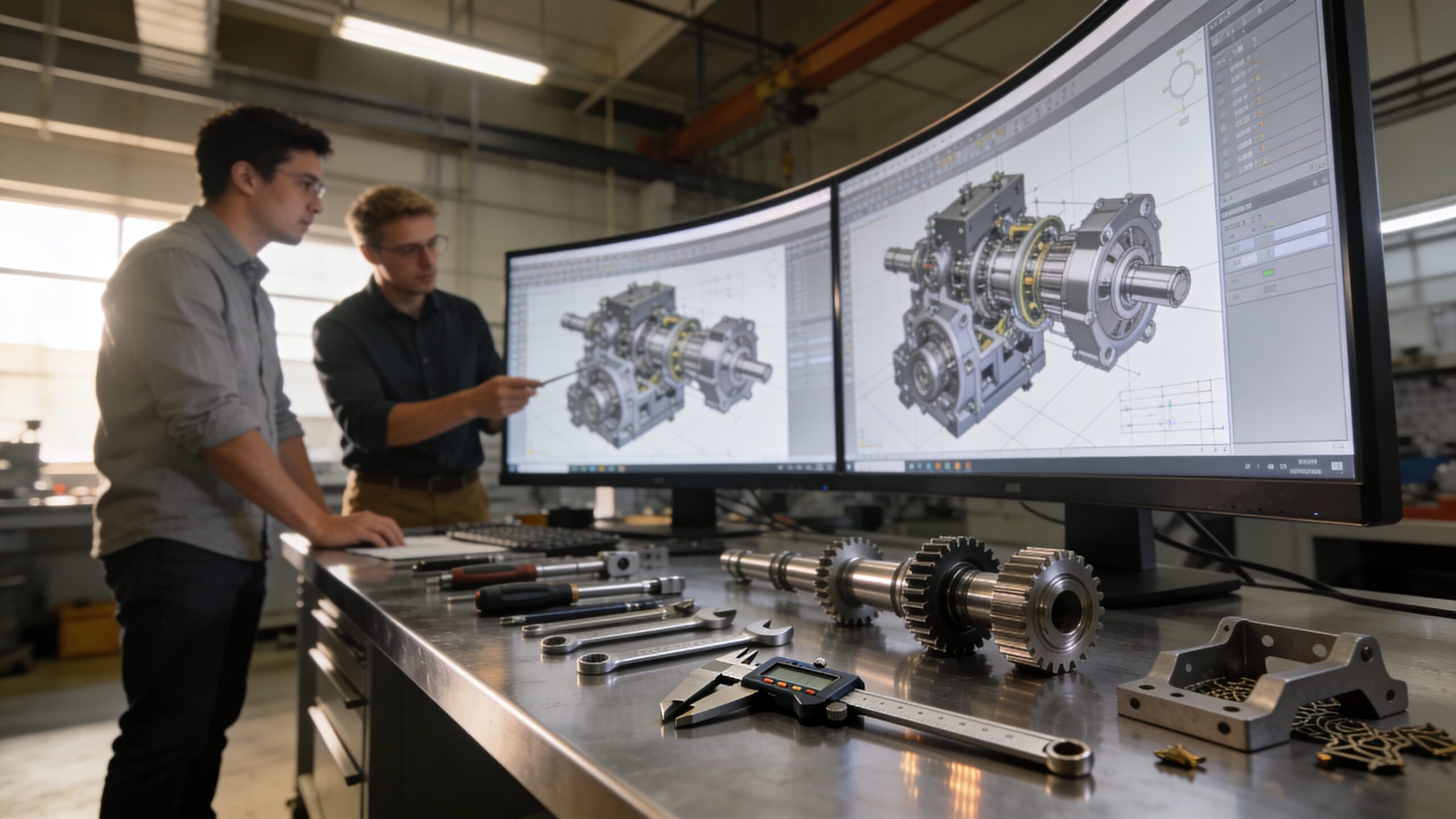
Computer-Aided Design, or CAD, has become one of the most important tools in modern mechanical design. CAD allows engineers to create detailed 3D models, test fit assemblies, check clearances, generate drawings, and communicate design intent. It gives designers the ability to see a machine before it exists physically, which reduces mistakes and speeds up development. CAD is more than digital drawing. A well-built model can include relationships between parts, motion studies, exploded views, manufacturing details, and revision history. It becomes a living representation of the machine. For beginners, CAD is often the gateway into mechanical design. For professionals, it is the central workspace where ideas become engineered products.
Simulation and Engineering Analysis
Modern mechanical design often uses simulation to predict how a machine will behave before physical testing begins. Finite Element Analysis can show where stress concentrates in a bracket, frame, or housing. Motion simulation can reveal collisions, poor linkages, or unexpected movement. Thermal analysis can help designers understand heat buildup, while vibration analysis can identify resonance risks.
Simulation does not replace engineering judgment, but it gives designers a powerful way to improve designs earlier. A model is only as good as the assumptions behind it, so engineers must use realistic loads, constraints, materials, and boundary conditions. When used correctly, simulation reduces guesswork and helps teams build safer, lighter, stronger, and more efficient machines.
Prototyping the First Version
A prototype is where the design meets reality. Even the best model can miss issues that appear only when parts are touched, assembled, loaded, or operated. Prototypes help engineers test fit, motion, comfort, strength, serviceability, and user experience. They reveal whether the machine behaves as intended or needs another round of refinement. Prototypes can be simple or advanced. Early versions may use 3D-printed parts, off-the-shelf components, wood, foam, or rough metal pieces. Later prototypes may closely match the final product. The goal is not perfection at the beginning. The goal is learning. Each prototype answers questions that drawings and calculations cannot fully resolve.
Testing, Failure, and Improvement
Testing is one of the most valuable parts of mechanical design because it reveals the truth. A machine may look excellent on screen but struggle under real loads, repeated cycles, or rough handling. Testing helps engineers discover weak points, unexpected vibration, overheating, noise, wear, assembly difficulties, or user problems. This feedback drives better design decisions.
Failure is not always bad during development. In fact, controlled failure can be extremely useful because it shows where the design needs improvement. Engineers study broken parts, worn surfaces, loose fasteners, and deformed structures to understand what happened. A strong design process treats failure as information, not embarrassment.
Designing for Manufacturing
A machine is not truly complete until it can be made efficiently. Design for Manufacturing means creating parts that match available production processes. A component may be machined, cast, stamped, molded, welded, forged, laser-cut, 3D-printed, or assembled from standard stock. Each process has limits, costs, and best practices. Good manufacturing design reduces unnecessary complexity. It avoids impossible shapes, excessive machining, hard-to-reach features, and materials that are difficult to process. It also considers production volume. A one-off prototype can be expensive and slow to build, but a mass-produced machine needs repeatable processes, controlled quality, and efficient assembly.
Designing for Assembly and Maintenance
Machines should not only work well; they should be practical to assemble, inspect, repair, and maintain. Design for Assembly focuses on reducing part count, simplifying alignment, using standard fasteners, and making build steps logical. A machine that is difficult to assemble can increase cost and introduce quality problems.
Maintenance matters because real machines wear, loosen, get dirty, and need service. Designers can improve maintenance by making filters, belts, bearings, fasteners, and access panels easy to reach. A machine that is simple to repair often lasts longer and creates less frustration for users. Great mechanical design thinks beyond the first day of operation.
Safety in Mechanical Design
Safety is not an optional layer added at the end. It must be built into the machine from the beginning. Mechanical designers consider pinch points, sharp edges, rotating parts, stored energy, hot surfaces, electrical integration, structural failure, and user misuse. Guards, shields, interlocks, stops, labels, and controlled access points can all reduce risk. A safe machine also behaves predictably. It should not tip easily, jam dangerously, overload silently, or fail without warning. Designers use safety factors, testing, standards, and risk assessments to protect users and equipment. The best safety features are often the ones that feel natural, because they guide people toward correct use without making the machine difficult to operate.
Balancing Cost, Performance, and Simplicity
Mechanical design is full of trade-offs. A stronger part may cost more. A lighter material may be harder to manufacture. A more compact layout may be more difficult to service. A faster machine may create more heat, vibration, or wear. Engineers must constantly balance competing priorities to create a design that succeeds in the real world.
This balancing act is what makes mechanical design so interesting. There is rarely one perfect answer. Instead, designers search for the best possible compromise based on the product’s goals. A successful machine delivers the required performance at the right cost, with acceptable reliability, manufacturability, safety, and user experience.
The Role of Modern Innovation
Mechanical design is evolving quickly as new tools and technologies reshape engineering. Generative design, additive manufacturing, smart materials, digital twins, advanced simulation, robotics, and AI-assisted workflows are giving engineers more ways to explore solutions. These tools can help create lighter structures, faster prototypes, and more optimized systems. Still, the fundamentals remain essential. New technology cannot replace a strong understanding of forces, materials, motion, tolerances, and manufacturing. The future of mechanical design belongs to engineers who can combine timeless principles with modern tools. Innovation works best when it is grounded in mechanical reality.
How Beginners Can Start Learning Mechanical Design
Beginners should start with the basics: sketching, simple mechanisms, materials, fasteners, measurements, and CAD modeling. Small projects are often the best teachers because they reveal how real parts fit and move. Building a bracket, hinge, clamp, gear assembly, small robot, or hand-powered mechanism can teach more than theory alone.
Learning mechanical design also means developing curiosity. Take apart old machines, study how products are assembled, notice how parts are shaped, and ask why certain materials were chosen. Over time, patterns begin to appear. You start to see design decisions hidden inside everyday objects, and that awareness becomes the foundation of engineering skill.
Why Mechanical Design Still Matters
Mechanical design remains one of the most important fields in engineering because the physical world still needs machines. Even in an age of software, artificial intelligence, and digital automation, something must move, hold, cool, lift, protect, cut, pump, spin, or support. Mechanical design gives technology a body. From clean energy systems to medical devices, from manufacturing robots to aerospace structures, modern progress depends on machines that are thoughtfully engineered. Mechanical design turns imagination into working reality. It is where creativity meets physics, where ideas become mechanisms, and where raw problems become powerful solutions.