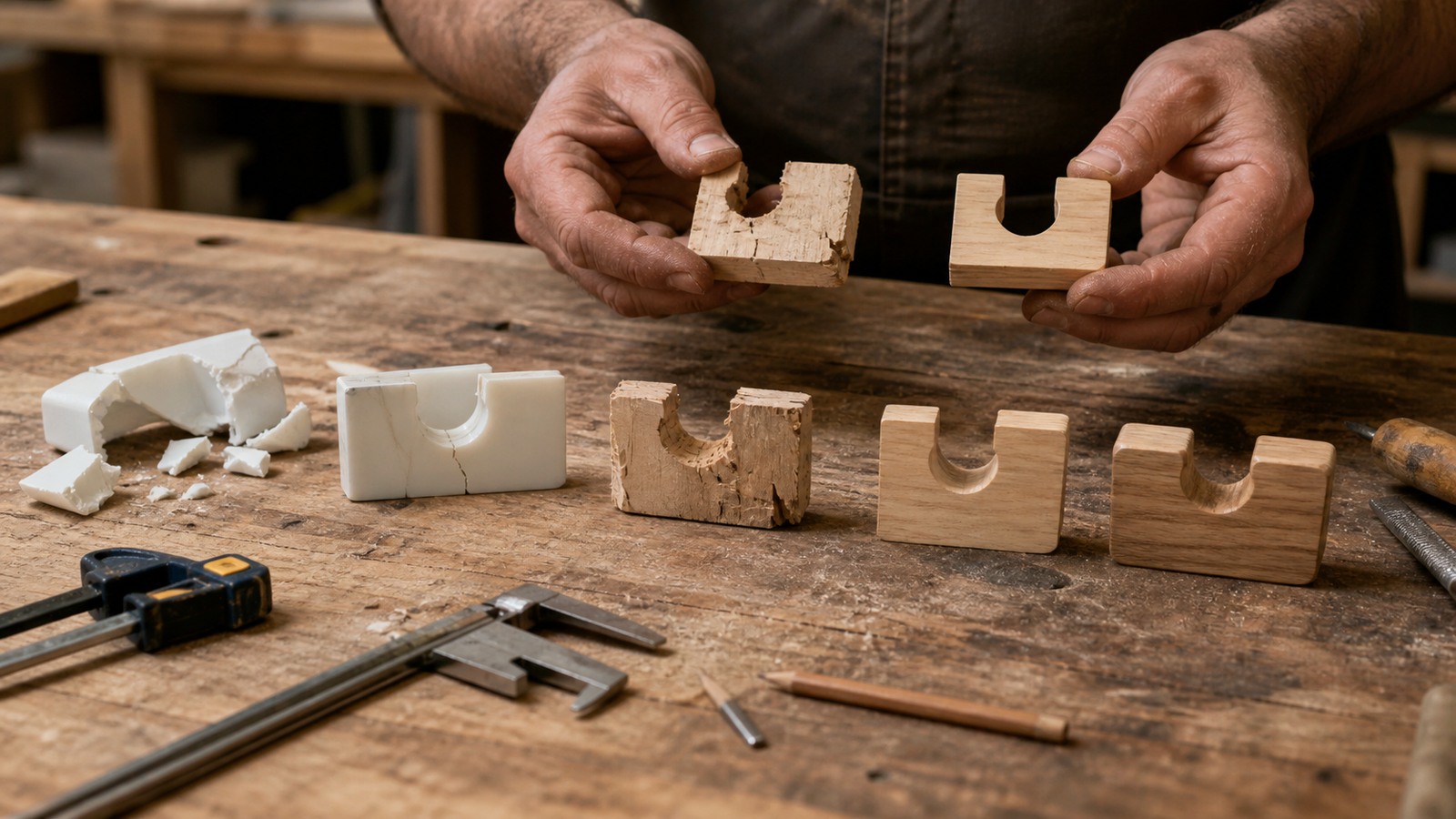
The Best Beginner Project Is A Skill Ladder
The best woodworking projects to learn core skills are not always the flashiest projects. They are builds that teach measuring, marking, sawing, planing, drilling, shaping, joinery, sanding, finishing, and assembly in a sequence the maker can actually understand. A good learning project has enough challenge to reveal technique, enough usefulness to justify the effort, and enough restraint that mistakes become lessons rather than disasters.
A: Start with the smallest test that proves one real part of the project.
A: Enough to know the goal, material limits, tool setup, and first safety check.
A: No. It should be clear, testable, and easy to revise.
A: Early failures usually come from poor first layers, wrong temperatures, weak orientation, wet filament, bad supports, and unfinished cleanup.
A: Match the material to load, use, finish, cost, repair, and available tools.
A: Scale after a small test works repeatedly and the cost still makes sense.
A: Save measurements, settings, suppliers, photos, failures, and changes.
A: Rework drops, fit improves, safety is clearer, and results repeat more often.
A: Avoid hiding weak structure, unsafe setup, or unclear decisions under a nice finish.
A: It solves the intended job and teaches a better next build.
Choose Projects That Teach One Main Lesson
A beginner project should not try to teach every woodworking skill at once. When the main lesson is clear, the maker knows what success means. A bench hook may teach square layout and straight sawing. A tray may teach edge treatment and assembly. A box may teach squareness and patience.
This focus does not make the project boring. It makes the feedback legible. If too many new skills appear at once, the maker may finish with an object but no clear sense of what improved.
Start With Shop Aids
Shop-made aids are excellent first projects because they improve future work. A bench hook, shooting board, sanding block, clamp rack, simple mallet, or tool tray can be rough but useful. These projects teach layout, cutting, fastening, and function while staying close to the bench.
There is also a quiet confidence in using a tool you made to make another object. The shop begins to teach itself.
Shelves Teach Practical Accuracy
A simple shelf is more than a board on brackets. It teaches measuring a real space, finding support, drilling pilot holes, leveling, sanding visible surfaces, and choosing a finish appropriate to use. If the shelf is slightly out, the wall will announce it.
Because shelves are useful, they encourage care. The maker learns that woodworking accuracy lives not only on the bench but also during installation and use.
Trays Teach Touch And Corners
A tray is a compact lesson in proportion, corners, edges, sanding, and how an object feels in the hand. It may use butt joints, rabbets, miters, handles, or simple dividers. The project is small enough to finish but rich enough to reveal sloppy layout or rough edges.
Trays also teach restraint. Too much decoration can make them awkward. A clean tray with smooth edges and square corners often teaches more than an overcomplicated one.
Boxes Teach Squareness Honestly
Boxes are classic learning projects because they reveal truth from every direction. Parts must match, corners must close, lids must fit, and small errors become visible. A box can be simple, but it asks the maker to care about sequence, clamps, diagonals, and surface preparation.
Start with a small utility box before attempting fine heirloom work. The lesson is not perfection; it is learning how parts relate in three dimensions.
Stools And Stands Teach Strength
A stool, plant stand, or small bench introduces load, stance, racking, and comfort. The project must not only look square but behave well under weight. This teaches why joinery direction, fasteners, glue surfaces, grain, and proportions matter.
Strength projects should be conservative. Test them carefully, choose appropriate material, and avoid clever weak details until the basics are understood.
Frames Teach Visual Precision
Picture frames, mirror frames, and small display frames teach miters, grain selection, clamping strategy, and visual alignment. A tiny gap at a miter is easy to see, which makes frames demanding in a useful way. They reward careful setup and patient test cuts.
Frames are also good lessons in finish because the viewer looks closely. Surface preparation becomes part of the project, not an afterthought.
Repair Projects Teach Real Consequences
Repairing a loose chair rung, cracked drawer, broken handle, or worn shelf bracket teaches how objects fail. Unlike a fresh plan, repair work reveals stress, wear, previous mistakes, and material limits. The maker must diagnose before acting.
Repair is an especially valuable core skill because it connects woodworking to stewardship. A fixed object teaches practical judgment that new builds sometimes avoid.
Repeat To Measure Progress
A single project can feel successful for many reasons: luck, forgiving material, simple design, or careful work. Repeating a project shows what really changed. The second tray, box, shelf, or stool often takes less time and reveals better control.
Repetition is not wasted creativity. It is how skill becomes reliable. Musicians practice scales, and woodworkers can practice useful forms.
Build A Ladder, Not A Trophy Case
The best woodworking learning path is a ladder of projects where each rung adds one or two new demands. Shop aid, shelf, tray, box, frame, stool, cutting board, cabinet, and repair work can all belong if the sequence makes sense. The goal is not collecting beginner projects. The goal is growing judgment.
When a project is finished, ask what skill it strengthened and what the next project should ask. That question turns woodworking from random effort into steady progress.
Practice Boards Still Have A Place
Useful projects are motivating, but plain practice boards still matter. A board filled with saw starts, chisel lines, plane tracks, holes, and layout marks gives immediate feedback without risking a finished object. It lets the maker isolate a motion and repeat it until the tool feels less mysterious.
The trick is to practice with intention. Do not randomly cut scrap until it becomes firewood. Choose one skill, mark a clear target, make several attempts, and compare the results.
A Simple Box Can Become Many Lessons
The word box sounds humble, but boxes contain a surprising amount of woodworking education. They require four sides to agree, a bottom to fit, a lid or opening to behave, and surfaces to finish cleanly. A box can teach butt joints, rabbets, grooves, miters, hinges, pulls, and lining depending on how it is designed.
Because boxes are scalable, they make excellent repeat projects. A rough shop box, a nicer keepsake box, and a drawer insert can all teach different versions of the same core geometry.
Jigs Teach Accuracy And Self-Reliance
Making a jig teaches the maker to solve repeatability problems. A crosscut guide, drilling template, router guide, sanding block, or assembly square may not be glamorous, but it improves future projects. It also forces the maker to think about reference edges, stops, pressure, and error transfer.
A jig does not need to last forever. Some are temporary helpers for one project. Others become permanent shop companions. Both kinds build practical judgment.
Finishing Projects Teach Patience Late In The Build
Many beginners treat finish as the quick reward after construction, then discover that it magnifies every scratch, glue smear, and sanding shortcut. A good learning project includes enough visible surface to teach preparation but not so much that finishing becomes overwhelming. Trays, frames, small shelves, and boxes work well for this.
Make sample boards before committing to the actual project. Seeing color, sheen, and texture on the same wood prevents disappointment and teaches finishing as a skill rather than a gamble.
Hardware Adds Real-World Tolerances
Hinges, pulls, brackets, screws, threaded inserts, and slides add another level of accuracy. A box with a lid teaches hinge mortises and alignment. A shelf teaches wall anchors and pilot holes. A tool tote teaches handle placement and fastener strength. Hardware makes the object interact with real forces.
Introduce hardware gradually. One hinge lesson learned well is better than a project crowded with mechanisms that all need troubleshooting at once.
Good Learning Projects Invite Reflection
The project is not complete as a lesson until the maker reflects on it. Which measurement mattered most? Which tool felt uncontrolled? Which step should move earlier next time? Which surface was overworked? Which detail deserved more time? These questions turn a finished object into skill growth.
Reflection should be specific and brief. A few honest notes can guide the next build more effectively than vague frustration or vague pride.
Match Wood Choice To The Lesson
Wood species affects the lesson. Construction lumber is cheap but may twist, dent, and contain knots. Poplar is approachable and paint-friendly. Pine teaches softness and tearout. Hard maple rewards sharp tools but can punish dull ones. Plywood teaches sheet layout and edge treatment.
Choose material that supports the skill being learned. Expensive wood can make beginners timid, while terrible wood can make good technique look bad.
Installation Can Be Part Of The Project
Some learning projects do not end at the bench. A shelf, hook rail, wall cabinet, or plant stand must be installed, leveled, supported, and used. This teaches anchors, studs, shims, clearances, and the difference between a nice object and a functioning one.
Installation adds reality. The wall, floor, and user become part of the woodworking lesson.
Keep The Next Project Connected
A good progression links one project to the next. If a tray taught edge treatment, the next box can add squareness. If a box taught squareness, a small cabinet can add doors. If a stool taught strength, a bench can add scale. Connected projects prevent learning from scattering.
This connection also keeps motivation practical. Each build feels like part of a growing skill set rather than an isolated attempt to make something impressive.
Learn To Read Errors Without Drama
Core-skill projects are valuable because they make errors visible at a survivable scale. A gap at a miter, a rocking stool, a lid that binds, or a shelf that leans gives specific information. The maker can ask whether the problem came from layout, cutting, clamping, sanding, hardware, or wood movement.
This calm diagnosis is a skill in itself. Woodworking improves faster when mistakes become evidence rather than insults.
Use Projects To Build Tool Fluency
Tool fluency means knowing what a tool feels like when it is working correctly. A saw tracks with less correction, a sharp plane takes consistent shavings, a chisel cuts without prying, and a drill starts where it was marked. Projects create the repetition needed to recognize those sensations.
This is why modest projects matter. They give the maker enough repeated contact with tools to develop feel, not just complete an object.
Let Use Judge The Lesson
After a learning project is done, use it. Put weight on the stool, keys on the shelf, pencils in the tray, or tools in the tote. Use reveals whether the project taught the right thing. A beautiful object that is annoying to use still has more to teach.
This final test keeps skill tied to purpose. Woodworking is not only making wood look good; it is making objects that behave well in daily life.
Let Confidence Grow From Finished Use
Confidence grows when a project leaves the bench and keeps working. A square box that stores bits, a shelf that stays level, or a stool that feels stable proves more than a photo of the build. The object becomes a quiet report card, returning feedback every time someone opens, carries, wipes, or leans on it.
Choose learning projects that enter daily life, because daily use keeps teaching after the last coat dries. Practical use reveals comfort, durability, balance, and finish quality in ways a bench inspection cannot.
When that feedback points to a flaw, record it without embarrassment. A loose screw, rough corner, or awkward proportion is exactly the kind of practical information a skill-building project is supposed to reveal.