Give Creativity Something Concrete to Work On
Being more creative does not have to begin with an extraordinary idea. You can practice noticing ordinary problems, changing a familiar arrangement, and making small alternatives that reveal possibilities you could not see in your head. For an everyday maker, those actions connect imagination with materials and use. The exercises in this guide work best when each has a small physical result: an observation sketch, several rough forms, a mechanism sample, or a useful change tested in its actual setting. You are not trying to prove originality with every session. You are building a wider range of ways to approach a project, compare possibilities, and choose which one deserves more work. Begin with a manageable object and let the exercises make your assumptions visible.
A: They can produce useful observations, comparisons, or small tests without becoming complete products.
A: A consistent job makes the structural differences easier to compare.
A: Start with one main feature so the consequences remain understandable.
A: Yes. Exploring an alternative can explain the value of an existing arrangement.
A: It opens another workable route while preserving safe work and the intended purpose.
A: No. It may demonstrate motion while leaving load and material behavior unresolved.
A: When one task obstructs another or the added complexity exceeds its practical benefit.
A: Preserve the source and the particular principle or problem the reference explains.
A: Their actions may reveal assumptions about access or use that the designer no longer notices.
A: State the finding and decide whether to test it further, apply it, or save it for later.
Exercise: Observe a Routine for Ten Minutes
Use a notebook or scrap paper and spend ten minutes watching one familiar routine, such as packing a work bag. Record the sequence without redesigning it immediately. Mark three moments when an item is hard to reach, something slips, or the same search is repeated. Choose one moment and describe the desired change without naming a new product. Your result should be a short problem statement grounded in an observed action, such as keeping a charging cable reachable after the bag is opened. Use that statement to guide the rough options in the next paragraph.
Pick one small friction point and phrase the desired change without naming a product. You might want a cable to remain reachable, a supply to be visible, or a loose component to stay separated during travel. That leaves room for several solutions instead of assuming that the answer must be a new container. Sketch or arrange three rough possibilities using simple available materials. Compare how each changes the routine, and preserve the observation that motivated it so the project does not drift into decoration without a purpose.
Exercise: Build a Holder in Three Materials
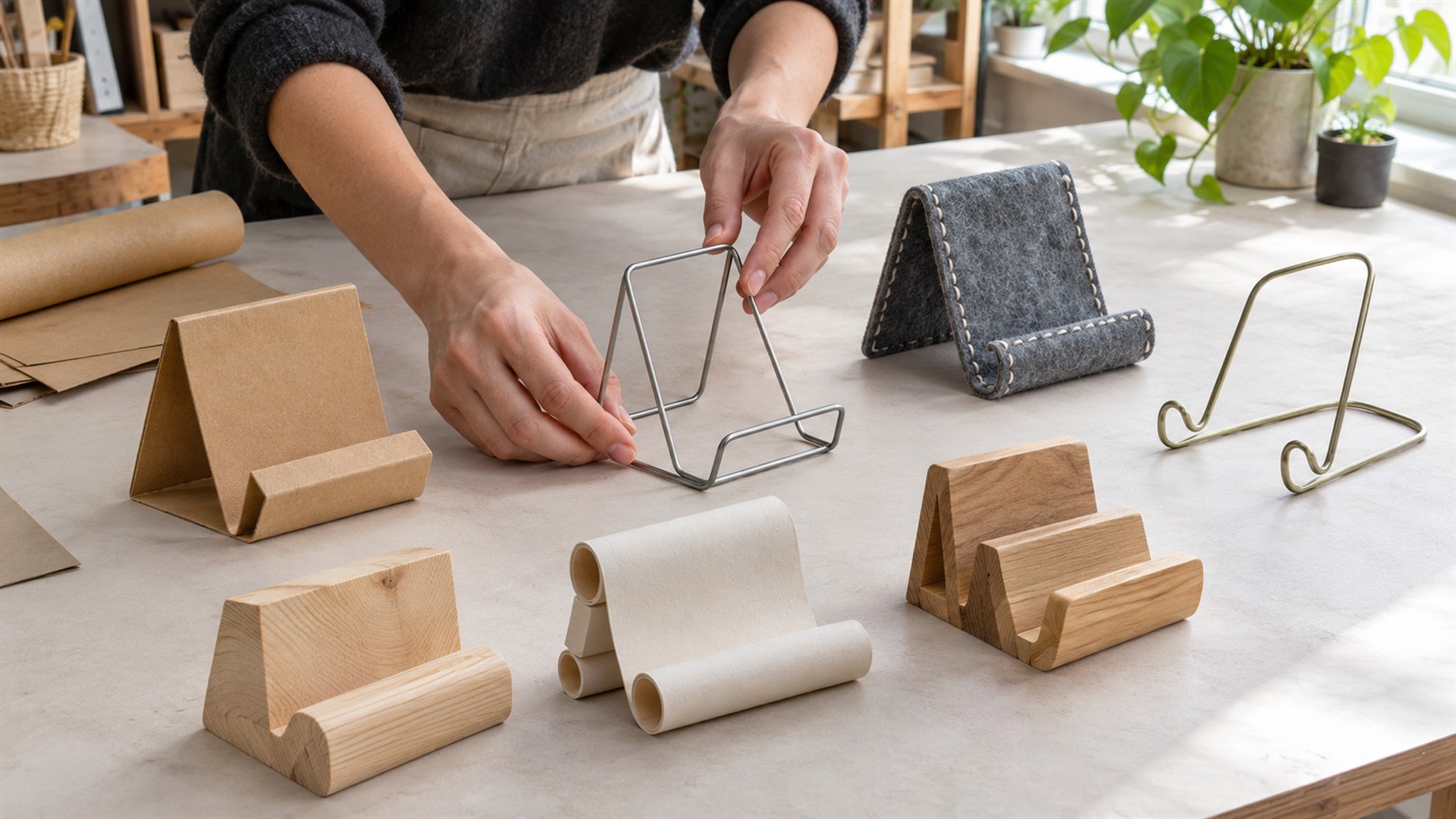
Allow about twenty minutes and choose three materials you can shape safely with familiar tools, such as card, felt, and suitable craft wire. Keep the job small: holding the same lightweight object upright on a table. Make one rough version in each material, allowing folds, loops, seams, or supports to differ rather than forcing identical shapes. Compare how each version meets the table, retains its contents, and resists tipping during gentle ordinary handling. Finish with a photograph and one sentence about the structural difference each material introduced. These are form experiments, not tests establishing strength for a demanding application.
Exercise: Make Three Different Openings
Set aside fifteen minutes with scrap card and tape. Choose a small container idea and keep its intended contents constant while drawing or folding three different openings. Make the alternatives visibly different, such as a top opening, a side opening, and a lower front cutout. Do not spend the time decorating or refining the first promising version. The output is a set you can place together and compare using the same retrieval action. Keep the rest of the design stable enough that you can explain which difference comes from the opening itself.
Arrange the alternatives together and describe their practical differences. One opening may be easier to reach, another may retain contents more securely, and a third may be simpler to fabricate. Select a promising feature for a later prototype without pretending that the rough comparison establishes every aspect of the finished design. You may combine useful details, but check whether they remain compatible. An elegant handle from one version may interfere with the lid chosen from another, so a new combination still needs testing.
Keep the rejected alternatives long enough to photograph or sketch the feature you learned from them. You do not need to store every scrap indefinitely. A short record can preserve a structural idea for another project without allowing exploratory clutter to consume the work area. The purpose of producing several forms is broader experience with the problem, not a permanent collection of unfinished miniature obligations. Finish the exercise by choosing what you learned and deciding whether one option merits further work.
Exercise: Borrow a Fold or Latch
Choose an ordinary clean carton or other safe accessible object and spend fifteen minutes observing one fold, latch, or sliding relationship. Use paper to model the movement after describing what it does. Your aim is a sample that demonstrates a principle, such as a tab retaining a flap, rather than a replica of the whole product. Keep tools and materials appropriate to the small trial and do not dismantle hazardous equipment for inspiration. End by naming a project where the movement might help and one condition that would need a separate test.
Ask what changes when the mechanism moves into the new setting. Scale, thickness, friction, access, and expected wear may make a direct transfer unsuitable. A paper latch can demonstrate motion without proving that a larger version will hold a load. Treat the borrowed principle as a starting hypothesis and test its new conditions. Respect applicable design rights and licenses when reproducing or distributing work; studying how a mechanism behaves and making commercial copies of a protected product are different activities.
Exercise: Work With One Sheet
Give yourself fifteen minutes, one sheet of card, and a small job such as holding several lightweight paper slips. Decide which familiar construction the limit removes, then fold or shape an alternative using a safe familiar method. Keep the required function intact rather than treating inconvenience as the goal. Stanford d.school’s method cards describe constraints as a way to direct creative exploration. Finish with one rough form and a sentence explaining the route the restriction helped you discover. Change the restriction if it prevents a usable result rather than opening another possibility.
Exercise: Reverse One Design Assumption
Use scrap paper for a ten-minute sketch comparison. Name one assumption in a familiar object, such as a tray sitting horizontally or a container opening at the top, then sketch the reversed arrangement. Keep the same user and job while identifying what must change in access, retention, or attachment. Produce two labeled sketches or simple folded forms that make the relationship easy to see. The useful output is not an automatically better design, but an explanation of one advantage and one new difficulty introduced by the reversal.
Build a rough representation of the changed relationship and test the consequence that matters. A different orientation can alter retention, reach, stability, cleaning, or attachment loads. Identify those effects before deciding the reversal is an improvement. Sometimes the exercise explains why the familiar arrangement works so well, which is useful knowledge too. Creativity includes understanding constraints and making a reasoned choice to retain a good existing solution after exploring an alternative.
Try the same exercise on an assembly sequence rather than only a finished shape. Could a component be replaced before the enclosure is removed, or could a soft sleeve detach for cleaning? Reversing the order may reveal service access that a static sketch overlooks. Make a simple sequence of actions and check whether one step blocks another. The exercise can lead to practical originality in how an object is used and maintained, even when its outward appearance remains straightforward.
Exercise: Combine Two Related Jobs
Allow twenty minutes with paper and a familiar tabletop routine. Choose two jobs that happen together, such as retaining a cable and holding small desk items, and describe each job before sketching their combination. Make a rough arrangement showing where the contents and cable would sit. Then sketch two simple separate objects performing the same tasks. Your result is a comparison between combined and separate arrangements, with a clear reason to prefer one. Avoid adding a second function simply because there is empty space in the first object’s outline.
Test whether the combined version makes either task worse. A convenient cable position may obstruct the tray’s opening, and a dense travel organizer may become awkward to pack. Compare the combination with two simple separate objects. If the separate arrangement works better, the experiment has still clarified the relationship. Combining functions is one creative technique rather than a universal improvement, and the finished choice should follow the evidence from actual handling.
Exercise: Watch Someone Use the Rough Version
Ask a willing person for a ten-minute handling trial using a prototype suited to the task. Give one short instruction, such as retrieving a particular item, and observe the first action before offering a full explanation. Keep the trial within what the rough model can safely demonstrate; paper may show reach without supporting a real load. Record the action you expected, what actually happened, and the design feature that may explain the difference. The output is one revision to test, based on observed use rather than a general request for approval.
Keep an Exercise Record You Can Reuse
Collect references around a design problem and write the principle each one explains. A saved photograph might show a fold that stiffens a surface, a liner that detaches for cleaning, or a handle with finger clearance. Preserve the source along with the useful observation. Add your own rough trials using the same approach. The examples below illustrate the kind of record to keep; they are possible findings to investigate rather than results every exercise must produce.
| Exercise output | Finding to describe | Follow-up that would test it |
|---|---|---|
| Three material holders | The soft version needs support in a place where the folded card supports itself. | Add one appropriate backing and compare the same gentle handling action. |
| Three opening mockups | One opening allows retrieval while the contents remain visible. | Try it in representative material and check whether thickness changes access. |
| Combined desk arrangement | The cable interferes with the hand reaching into the tray. | Move the cable path, then compare it with keeping two separate objects. |
| Short user trial | The participant first reaches for a different edge than expected. | Clarify that edge or change the opening, then repeat the same task without extra coaching. |
Record a failed comparison just as specifically when it exposes a limit. A paper latch may demonstrate a movement without telling you whether the final material will retain a load, and a pleasing sketch may remain awkward when folded to size. Review a small relevant set of records when beginning a project, then put it aside long enough to work. The collection should help choose or test a feature. It does not need to become an archive of every attractive image you encounter.
Choose One Finding to Carry Into a Project
End with the physical sample, sketch, or observation the exercise produced and name the finding it supports. A material comparison may reveal a need for stiffness, while a handling trial may reveal an awkward opening. Choose whether to test that feature further, use it in a current project, or save it with its context for later. Do not turn every exercise into another obligation to build a finished product. The purpose is a wider set of approaches you can choose from when a real design problem appears, with enough concrete evidence to explain what each approach taught you.