Let the Practice Piece Tell You What to Learn Next
A crooked seam or loose joint can seem to say something permanent about your ability when you are learning a hands-on skill. In practice, it describes a result produced by particular materials, movements, tools, and decisions. Those details offer places to investigate. A growth mindset treats improvement as possible while recognizing that progress depends on useful practice, appropriate instruction, feedback, and workable conditions. It does not require pretending that a poor result is good or that effort alone solves every problem. For a maker, the useful habit is learning how to turn an imperfect sample into a more precise next attempt. That means narrowing the skill, observing the process, and changing what the evidence suggests rather than repeatedly judging whether you are naturally talented.
A: No. Evaluate the work honestly while keeping improvement and a change of method possible.
A: Effort does not replace appropriate equipment, instruction, or safe working conditions.
A: They isolate the feature being learned and make comparisons easier.
A: Study one observable operation and choose an achievable component to practice.
A: Inspect the target, technique, setup, and instruction before increasing repetitions.
A: Use comparable evidence across attempts rather than treating one session as a complete verdict.
A: Observing the process may reveal a cause that the finished sample cannot show.
A: No. Attend to comfort, fatigue, and safe control as conditions for useful practice.
A: Choose a small manageable object once the focused movement has become reasonably dependable.
A: Describe the improvement, remaining inconsistency, and strategy that shaped the result.
Replace a Broad Verdict With a Specific Observation
When a result disappoints you, describe what can actually be seen or measured. The seam may wander away from its allowance, the cut may lean out of square, or the clay wall may become thinner near the rim. These descriptions are more useful than deciding that you are bad at sewing, woodworking, or pottery. They preserve the possibility that one part of the process can change. A precise observation also makes it easier for an instructor to help, because there is a defined result to compare with the intended movement.
Keep the observation separate from the explanation until you have enough evidence. A crooked cut might involve marking, workholding, blade condition, body position, or the way the tool is guided. Blaming shaky hands immediately can hide a setup problem that is easier to correct. Choose a plausible cause and test it without claiming certainty. This approach gives you a way to learn even when the first explanation turns out to be wrong, because the comparison still reduces uncertainty about the process.
Understand What Growth Mindset Does and Does Not Promise
Educational resources such as MIT’s growth-mindset guidance connect a belief in developing ability with responses such as trying different strategies and seeking feedback. Applying that idea at the bench means allowing room for improvement while taking the method seriously. It is not a guarantee that every person will progress at the same rate, reach the same outcome, or overcome unsuitable equipment through determination. Materials, access, teaching, time, physical comfort, and prior experience can all affect what practice makes possible. An encouraging belief becomes useful when it supports concrete learning actions rather than replacing them with a demand to remain positive.
Choose One Skill Small Enough to Practice Deliberately
A whole project contains many different skills, so repeating the project may obscure which one needs attention. Break the difficulty into a smaller operation that still resembles the real task. A short straight seam can isolate fabric guidance, while a sample joint can focus attention on layout and fit. Choose a result you can inspect at the end of the attempt. The aim is to make the relationship between your action and its consequence easier to see, not to strip away every condition until the exercise no longer resembles the work you want to learn.
Set the difficulty just beyond what you can already do reliably. A task that is overwhelmingly complex may leave you unable to identify the cause of an error, while a familiar easy task may provide little new information. Adjust the material, size, or number of simultaneous operations to create a useful challenge. If the technique involves hazards, learn its safe setup and obtain appropriate supervision before treating repeated attempts as independent practice. A learning goal never replaces the conditions needed to use a tool responsibly.
Define success narrowly for the exercise. You might aim for a more consistent allowance over a short seam or a joint that seats without the previous visible gap. Avoid demanding speed, appearance, precision, and a finished product from the same early trial. Once the movement becomes dependable, you can add another requirement. A small clear target helps you recognize partial improvement without pretending that the entire craft has been mastered after one good sample. Decide how you will inspect the feature before you begin, so the evaluation does not drift toward whichever detail happens to look best afterward. A consistent viewing angle, matching reference piece, or simple measurement can be enough. Keep that method practical for the skill and avoid treating an uncertain measurement as more precise than it really is.
Follow One Learner Through Three Seam Trials
Consider an illustrative learner practicing a straight seam on stable woven scraps with appropriate instruction and a safe machine setup. Their target is a consistent allowance measured from the same fabric edge. In the first attempt, the seam wanders, so they describe the visible variation instead of concluding that they lack coordination. An instructor watches the next trial and helps them identify how the cloth is supported and which guide they are watching. They repeat the task on matching scraps, keeping the material and target steady so the adjustment can be compared.
| Illustrative trial | What the learner records | What happens next |
|---|---|---|
| First seam | Allowance varies, with the largest change near the start. | Ask an instructor to observe the starting movement. |
| Second seam | Start improves after a setup adjustment; drift remains later. | Practice guiding through the middle of a shorter sample. |
| Third seam | More consistent guiding on comparable scraps. | Repeat to check consistency before adding another demand. |
The table describes a possible learning record, not a guaranteed three-attempt progression. If the second seam did not improve, the learner would inspect the explanation or seek another demonstration. If one excellent sample appeared between several uneven ones, it would be encouraging without proving consistency. What makes the response constructive is the connection between an observation, a relevant change, and another comparable attempt. The learner’s belief in improvement supports those actions rather than replacing them with a demand to try harder indefinitely.
Ask an Instructor to Watch the Process
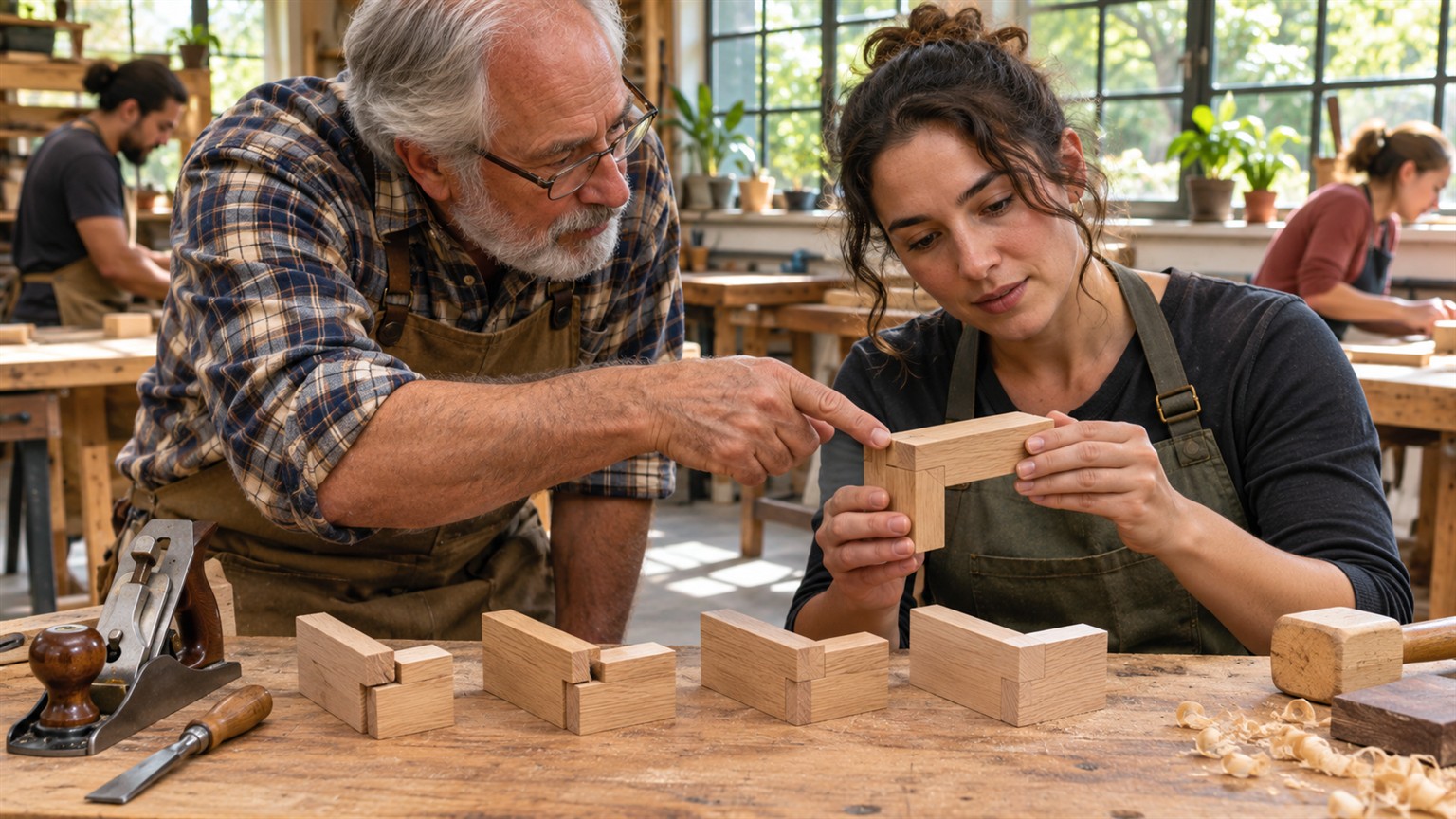
A finished sample shows the outcome, but an experienced observer may recognize a cause while you work. Ask them to watch a specific movement and compare it with the intended technique. Explain the result you are trying to improve and show what happened in the last attempt. A useful demonstration should make the relevant action visible, with time for you to try it and receive clarification. Watching someone perform the whole craft quickly may be impressive without giving you the information needed for your particular difficulty.
Repeat the explanation in your own words before practicing again. This can reveal whether you understood which part of the movement mattered or merely copied its general appearance. Ask about the conditions under which the advice applies, especially when materials or tools differ. A technique that works on one fabric, wood species, or component size may need adjustment elsewhere. Understanding the reason behind the instruction gives you a better basis for transferring it than memorizing a rule detached from its context.
Choose feedback that is specific enough to act on. General encouragement can make a learning environment pleasant, but it does not necessarily identify where to place your hand, how to support a part, or which surface should meet first. Likewise, harsh judgment without usable information offers little direction. Seek a description of the process, a manageable correction, and a way to inspect the next result. You are building a feedback relationship that improves the work rather than asking someone to certify your talent.
Keep the Seam Samples Comparable
Mark the practice pieces in order and compare the same allowance along the same edge. Keep the fabric, target, and viewing or measurement method consistent while investigating the guiding change. Record what the instructor suggested and whether you could repeat it without another prompt. Keep an ordinary early sample rather than preserving only the worst one, and judge the result across several attempts. This record can show a better start, less drift, or less rework even before the entire seam is dependable. A later difficult trial then becomes another result to investigate, with earlier evidence still available for comparison.
Change Strategy When Effort Stops Producing Information
If several attempts repeat the same defect, pause before increasing the number of repetitions. Inspect whether the practice target is too broad, the tool setup is unsuitable, the instruction is unclear, or an important condition has changed. Ask for a second demonstration or return to a simpler component of the task. Trying harder at the same unexamined movement may reinforce the pattern you want to change. A growth-oriented response includes changing the approach when the current one no longer teaches you anything.
Consider access and comfort as practical learning conditions. Poor lighting can make a layout line difficult to see, a work surface at an awkward height can affect control, and an unsuitable grip can create strain. Where possible, adjust the setup or seek guidance about equipment and technique that suit your circumstances. Rest when attention or comfort deteriorates, and stop unsafe tool use. Improvement does not require treating fatigue as proof of commitment. A better-supported session can provide more useful practice than extending a poor setup simply to accumulate time.
Use Other Makers as Sources of Technique
When you encounter impressive work, identify one observable technique you could study instead of comparing entire creative identities. Look at the seam finishing, joint preparation, edge treatment, or assembly sequence that contributes to the result. Ask how it was learned and what practice pieces helped. Skilled work often conceals the routine preparation and correction behind it, so a polished photograph is an incomplete account of the process. Learning from the operation gives you something usable, while a broad comparison may leave you with admiration but no next step.
Pay attention to differences in tools, materials, available time, and experience before treating another person’s result as your immediate standard. You can respect the quality without demanding that your next attempt match it. Choose an achievable component and try it under appropriate conditions. This keeps inspiration connected to learning rather than allowing every encounter with skill to become evidence that you should already be further ahead. The goal is a better relationship with the process you can actually practice.
Share your own work with a description of what you are learning when that feels useful. A small sample accompanied by its specific target invites more helpful discussion than an apology for not being an expert. You may discover that other makers recognize the same difficulty and can suggest a relevant exercise. Keep your own comparison record as the main evidence of progress, even while learning from the community. External reactions are additional information, not a replacement for understanding the skill yourself.
Finish a Small Project With the Skill You Have Developed
After focused practice, choose a modest project that uses the movement in context. Apply the same attention to preparation and inspection while accepting that a real object introduces other demands. Keep the project manageable enough to finish and evaluate. A completed pouch, simple jointed box, or small clay form gives you a chance to see whether the practiced operation transfers to useful work, and it may reveal the next skill that deserves its own exercise.
At the end, describe what improved, what remains inconsistent, and which strategy helped. Preserve one representative result and select a clear next target. A practical growth mindset becomes visible in these choices: you use evidence, seek relevant help, adjust the approach, and return with a task that can teach you something. Confidence may follow, but you do not need to wait for certainty about your abilities before doing that work. Give the practice piece an honest reading and let it point toward a better next attempt.