Innovation Often Starts As A Question On The Bench
Curiosity and tinkering create innovation by giving ideas a place to collide with materials. A maker wonders what would happen if a hinge moved differently, a scrap became a jig, a motor turned a mechanism, or a broken object revealed a better design. Real innovation is rarely a single dramatic flash. It is usually a chain of observations, small tests, surprising failures, and connections that become useful because someone stayed curious long enough to build them.
A: Tinkering becomes useful when it produces observations, tests, parts, or questions that improve future work.
A: Curiosity notices patterns and asks small questions that prototypes can answer physically.
A: Light boundaries help experiments stay safe, affordable, and memorable without removing surprise.
A: Use safe scraps, broken nonhazardous objects, simple mechanisms, and materials you can afford to ruin.
A: It reveals a repeatable behavior, solves a real annoyance, or creates a clearer next test.
A: Yes, repair exposes failure points, user habits, and design opportunities hidden inside finished objects.
A: Fear of waste, overplanning, unsafe risk, and rushing to polish before learning.
A: Use small bins, photos, quick notes, and time boxes so ideas remain findable.
A: When the experiment shows useful behavior that someone would want repeated.
A: No, it often comes from combining familiar materials, tools, and habits in a better way.
Curiosity Notices What Habit Ignores
Habit makes work efficient, but it can also make details invisible. Curiosity asks why a clamp slips, why a hinge feels wrong, why a toy mechanism works so well, or why a messy workaround keeps returning. Those questions expose design opportunities hidden inside ordinary life.
Innovation begins when a maker treats those observations as worth testing.
Tinkering Makes Questions Physical
A question in the mind can remain vague forever. A question on the bench has to deal with weight, friction, clearance, grain, electricity, glue, and human hands. Tinkering turns curiosity into physical evidence. It shows what an idea does when material pushes back.
This is why small experiments matter. They reveal reality before the concept becomes too polished to challenge.
Constraints Encourage Invention
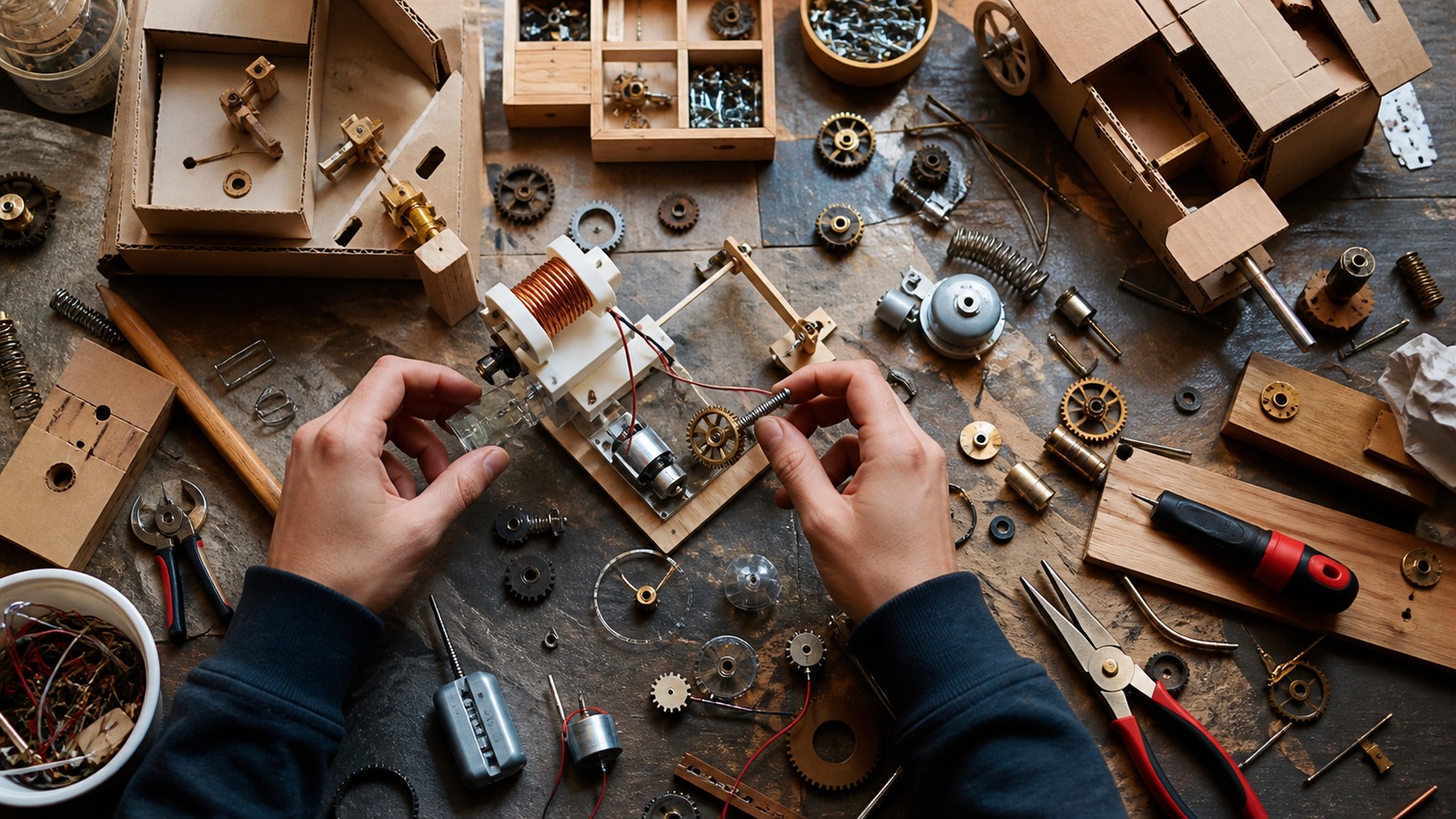
Limited tools, scraps, budget, space, and time can create better experiments because they narrow the field. A maker who only has cardboard, tape, a motor, and a few gears may find a simpler mechanism than someone with endless options. Constraints force choices.
The trick is to treat constraints as design partners rather than insults. They ask what is essential.
Cross-Craft Thinking Creates New Paths
Innovation often comes from borrowing. A sewing pattern can inspire flexible fabrication. A woodworking jig can guide plastic cutting. A 3D printed spacer can solve a hand-built assembly problem. A camera mount can inspire a shop fixture. Curiosity moves ideas across boundaries.
The maker advantage is practical translation. You can test whether the borrowed idea survives in a new material or scale.
Play Needs Safe Boundaries
Tinkering should be playful, but not careless. Electricity, chemicals, blades, heat, fumes, loads, and stored energy all need respect. Safe scraps and low-risk mechanisms are excellent playgrounds. Unknown hazards are not.
Boundaries keep curiosity sustainable. They make it possible to explore often without turning every experiment into a safety gamble.
Capture Accidents Before They Vanish
Some useful discoveries happen accidentally: a part fits another part, a scrap bends in a helpful way, a failed print becomes a jig, or a repair suggests a better design. These moments disappear quickly if not photographed or noted.
A quick note can preserve the insight long enough for a future project.
Move From Surprise To Repeatability
Innovation becomes real when a surprising behavior can be repeated and made useful. The rough experiment needs better material, clearer geometry, safer construction, or a more reliable process. This is where tinkering becomes design.
Do not polish too early. First make the useful behavior dependable.
Keep Curiosity Alive After The First Answer
The first answer is rarely the best answer. It is the door to better questions. What happens if the part is smaller, safer, cheaper, quieter, easier to repair, or easier for someone else to use? Curiosity keeps the idea improving.
Real innovation is not only discovery. It is discovery refined into something that works outside the original moment.
Create A Safe Tinkering Zone
A tinkering zone should invite experiments without endangering finished projects or household surfaces. Keep safe scraps, small mechanisms, cardboard, tape, low-voltage parts, hand tools, and containers for loose pieces in one place. Remove hazardous chemicals, unknown batteries, sharp blades, and risky materials from casual exploration. Curiosity works better when the boundaries are clear.
The zone does not need to be large. A tray, small table, or storage bin can be enough. The important thing is that experiments can begin quickly and be cleaned up before they become clutter. A sustainable tinkering habit respects space as much as imagination.
Follow The Mechanism Behind The Magic
Curiosity deepens when you ask how an object creates its effect. A latch clicks because geometry guides motion. A toy walks because a cam changes rotation into steps. A drawer slide feels smooth because friction is controlled. A tool feels balanced because weight and grip work together. Looking for mechanisms turns ordinary objects into lessons.
When you understand the mechanism, you can borrow the principle without copying the object. That is where innovation begins to form. The maker sees a pattern that can move into a new material, scale, or use.
Let Tinkering Stay Messy Early
Early tinkering should not be forced to look finished. Tape, clamps, cardboard, offcuts, and awkward temporary parts are allowed because the goal is discovery. Polishing too soon can protect a weak idea from useful criticism. A messy experiment invites adjustment.
The important distinction is between messy and unsafe. Messy can be productive. Unsafe should be redesigned before the test continues. Keeping that difference clear lets play remain responsible.
Connect Curiosity To User Friction
Tinkering becomes more innovative when it connects to a real friction point. A playful mechanism is interesting; a playful mechanism that makes a drawer easier to open, a tool easier to store, or a fixture easier to adjust becomes useful. Curiosity supplies possibilities, and observed need gives them direction.
This connection prevents novelty from becoming the whole goal. A clever device should still improve something for someone. Innovation is curiosity with usefulness attached.
Document The Odd Results
The strange results are often the valuable ones. A material bends without breaking, a gear ratio feels smoother than expected, a spring returns too sharply, or a cardboard shape fits a hand surprisingly well. These observations may not matter today, but they can become the seed of a later project.
Take quick photos and write short notes. Tinkering loses value when every discovery has to survive only in memory. A small record turns playful work into a reference library.
Refine Without Killing The Spark
Once an experiment becomes promising, refinement should preserve the original useful behavior. Makers sometimes improve an idea until they remove the quality that made it interesting. Keep the core observation visible: the motion, fit, texture, speed, or interaction that sparked the project.
Then improve around it. Make the part safer, stronger, easier to repeat, easier to repair, and easier for someone else to understand. Innovation matures when play and discipline stay connected.
Ask Better What-If Questions
Curiosity becomes powerful when the question is specific enough to test. What if this part were lighter? What if the hinge moved from the side? What if the tool stored vertically? What if the user could operate it with one hand? Specific what-if questions guide tinkering toward evidence instead of vague wandering.
The question should be small enough to answer physically. A quick mockup, weight test, motion test, or fit check can reveal whether the idea has promise. Good questions make playful work more productive without removing the play.
Use Disassembly As Education
Taking apart safe, unwanted objects can teach more than reading product descriptions. Inside, you see fasteners, pivots, springs, molded features, wear points, material thickness, and clever cost-saving choices. Disassembly shows how real objects solve constraints, not only how they look when finished.
The key is to observe rather than only harvest parts. Ask why a feature exists, what failed first, how assembly was made easier, and where the design compromised. Those observations can influence future maker projects in unexpected ways.
Give Experiments A Shelf Life
Tinkering can create clutter if every half-idea is kept forever. Give experiments a shelf life. If a part, mechanism, or mockup has not taught anything further after a reasonable time, photograph it, save the useful notes, and reclaim the space. Curiosity needs room to keep moving.
This keeps the tinkering habit healthy. The bench stays open for new questions, while the insight from old experiments remains available in notes and photos.
Turn Curiosity Into A Repeatable Practice
Curiosity grows when it has a rhythm. Spend occasional sessions taking apart objects, testing scrap materials, building tiny mechanisms, or exploring one tool without a final product in mind. These sessions fill the mind with options that later projects can draw from.
Innovation often appears to arrive suddenly because the preparation was quiet. Tinkering builds that preparation one small observation at a time.
Balance Wandering With Intent
Curiosity needs room to wander, but innovation needs enough intent to recognize value. A tinkering session can begin with no product goal, then shift when something useful appears. The maker’s job is to notice that shift. When a mechanism, material behavior, or layout starts solving a real problem, the session deserves a note and perhaps a prototype.
This balance prevents two extremes: overplanning every experiment until curiosity disappears, or collecting endless odd parts without turning any insight into use. Productive tinkering moves between play and purpose.
Use Constraints As Creative Prompts
A limited supply of parts can make better ideas. If only scrap wood, a spring, a hinge, and a small motor are available, the maker must understand the behavior of each piece. Constraint turns attention toward the essentials: motion, leverage, grip, balance, and sequence.
Many innovations begin this way because scarcity encourages recombination. The maker asks what the available parts can do together, not what perfect parts might do in theory.
Invite Other Eyes Into The Experiment
Someone else may see a use for an experiment that the maker misses. A child might use a mechanism differently, a friend might recognize a storage problem it solves, or another craftsperson might connect it to a technique from another field. Curiosity expands when ideas meet different experiences.
Share rough experiments carefully, without overselling them. Ask what people notice, what they would try, and where the behavior could be useful. Fresh observation can turn a small tinkering result into a real project direction.
Protect Beginner Wonder
Curiosity is easiest to lose when every experiment is judged by professional standards too soon. Beginner wonder has value because it asks obvious questions that experienced people may overlook. Why is this part shaped that way? Could this mechanism be smaller? What happens if the material is turned sideways? These questions can open paths that expertise has stopped seeing.
Skill should refine curiosity, not replace it. As makers learn more, they can test better, build safer, and recognize patterns faster. The original willingness to ask strange questions should remain intact.
Turn Tinkering Into Community Learning
Tinkering becomes more powerful when shared with other makers in a useful way. A small mechanism, failed experiment, clever jig, or unexpected material behavior can spark ideas for someone else’s project. Community feedback may also reveal risks or applications that the original maker missed.
Share the question, the setup, and the result. That makes the experiment teachable even if it never becomes a finished product. Innovation often spreads through these modest exchanges. The shared lesson may become more valuable than the original object, especially when another maker adapts it to a need you never saw before in practice, later.