Creativity Gets Stronger When It Has Something To Push Against
Design thinking improves creativity and innovation by giving imagination a better target. Instead of asking makers to wait for a perfect idea, it asks them to observe real behavior, define the problem more carefully, build small prototypes, test assumptions, and revise before the project becomes too expensive to change. The process does not make creativity less personal. It gives creative energy more contact with the people, materials, constraints, and messy evidence that turn a clever thought into a useful result.
A: Start with the smallest test that proves one real part of the project.
A: Enough to know the goal, material limits, tool setup, and first safety check.
A: No. It should be clear, testable, and easy to revise.
A: Early failures usually come from poor first layers, wrong temperatures, weak orientation, wet filament, bad supports, and unfinished cleanup.
A: Match the material to load, use, finish, cost, repair, and available tools.
A: Scale after a small test works repeatedly and the cost still makes sense.
A: Save measurements, settings, suppliers, photos, failures, and changes.
A: Rework drops, fit improves, safety is clearer, and results repeat more often.
A: Avoid hiding weak structure, unsafe setup, or unclear decisions under a nice finish.
A: It solves the intended job and teaches a better next build.
Creativity Needs Contact With Reality
A maker can generate ideas anywhere, but ideas improve when they rub against the world. A handle must fit a hand. A storage idea must fit a room. A fixture must survive clamping force. A product must be understood by someone who did not invent it. Design thinking helps creativity leave the private sketchbook and meet those realities early.
That contact is not a punishment. It is fuel. A constraint can suggest a new hinge, a user’s awkward reach can suggest a different profile, and a failed material test can reveal a better direction than the original sketch.
Observation Expands The Problem
Many projects begin with a solution disguised as a problem. A maker says they need a shelf, a bracket, a holder, or an enclosure. Observation may reveal the deeper need: the object is hard to reach, the workflow has too many steps, the surface is too small, the cable snags, or the user is trying to avoid cleanup. Better observation makes creativity less shallow.
The important habit is to watch behavior instead of only collecting opinions. People often request what they already know. Their workarounds reveal what they have learned to tolerate.
Framing Turns Chaos Into A Creative Brief
A good problem frame gives the project a useful boundary. It names the user, the setting, the friction, and the desired change. That frame does not lock the maker into one solution. It protects the maker from wandering into solutions that are exciting but irrelevant.
For example, make a better tool rack is weaker than help a renter store five frequently used hand tools without drilling into a wall. The second frame creates clearer constraints and more inventive possibilities.
Prototypes Make Ideas Negotiable
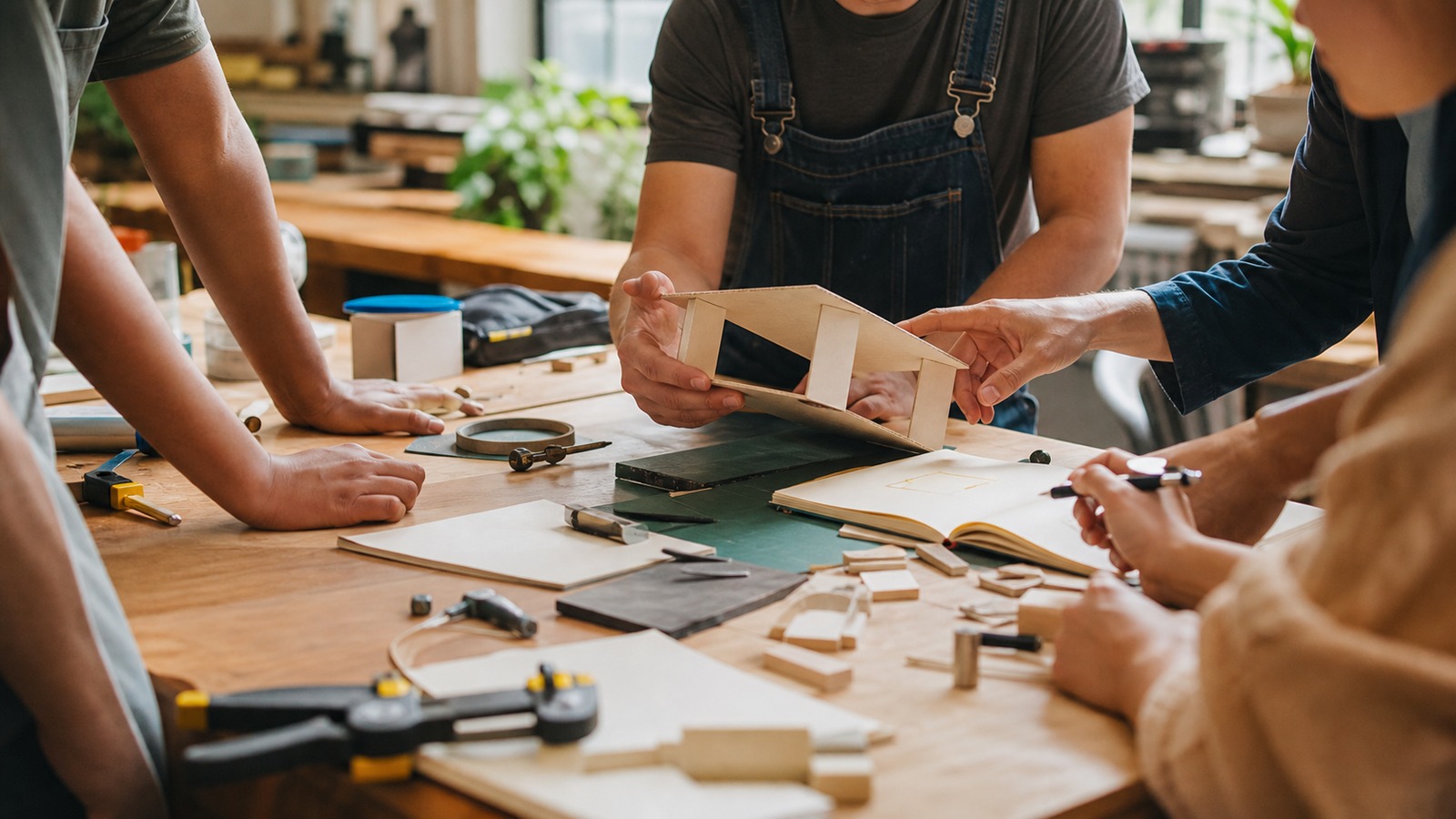
A prototype turns debate into evidence. Instead of arguing whether a shape will feel right, make a foam model. Instead of guessing whether a mechanism will clear the frame, build a scrap version. Instead of wondering whether the audience understands the object, hand them a rough mockup and watch.
The prototype does not need to look finished. In fact, roughness can help because people are more willing to criticize something that appears temporary. Early polish can make a weak idea feel too precious to question.
Feedback Protects Innovation From Ego
Innovation often fails when the maker falls in love with the idea before the idea has been tested. Feedback interrupts that pattern. It shows what users misunderstand, what feels awkward, what seems valuable, and what they ignore completely. That evidence can sting, but it protects the project from becoming a private performance.
Good feedback is specific. I like it is pleasant but thin. I could not grip it with gloves, I would not clean that groove, or I expected it to open the other way gives the maker something concrete to improve.
Iteration Creates Depth
The first version of a project is usually a guess with a shape. Iteration gives the guess a chance to learn. Each version should change something for a reason: handle angle, fastener access, material thickness, assembly order, weight, finish, cost, or the way the user discovers the function.
Iteration is not endless tinkering. It is disciplined change. If every version changes everything, the maker cannot tell what caused improvement. If no version changes enough, the project only repeats its first assumption.
Constraints Can Increase Originality
Unlimited freedom can flatten creativity because every direction is possible and none is urgent. A constraint asks sharper questions. What if the object must be made from scrap? What if it must fold flat, clean quickly, cost less, avoid power, use one hand, or survive outdoors? Constraints create productive tension.
This is why design thinking is useful for innovation. It does not simply ask for more ideas. It asks for better-fitting ideas. The originality comes from solving a particular problem with care.
Makers Have An Advantage
Makers can test ideas physically sooner than many teams can. Cardboard, foam, plywood, wire, clay, 3D prints, tape, clamps, and scrap hardware make ideas tangible quickly. That speed lets a maker learn while the concept is still flexible.
The advantage grows when makers document their tests. Photos, notes, measurements, and quick observations create a trail of decisions. Without that trail, useful lessons can disappear into memory.
Innovation Should Survive Use
A creative object is not automatically innovative. Innovation changes something in practice. It makes a task safer, clearer, faster, more repairable, more accessible, more durable, more expressive, or more satisfying. Design thinking keeps that outcome visible while the maker explores.
The final question is not whether the idea is clever. It is whether the design learned enough from reality to deserve trust. When creativity and evidence work together, innovation becomes less mysterious and more buildable.
Divergent And Convergent Thinking Both Belong
Design thinking helps creativity because it separates expansion from selection. In one phase, the maker explores many possibilities without demanding immediate perfection. In another phase, the maker compares ideas against evidence and constraints. Mixing those phases too early can make ideas timid; refusing to converge can make the project endless.
A practical maker might sketch ten handle shapes, mock up three in foam, test two with a user, and refine one. That sequence keeps creativity broad at the start and focused when commitment matters.
Empathy Is Practical, Not Sentimental
Empathy in design thinking does not mean guessing what people feel. It means learning how they actually use, avoid, carry, store, clean, repair, or misunderstand the object. A maker who watches a real task may discover that the best innovation is not more features, but less awkwardness.
This is especially powerful in workshop and DIY contexts. Someone may say they need more storage when the real issue is that the frequently used tool is stored below knee height. Empathy finds the physical details that abstract brainstorming misses.
Innovation Often Comes From Reframing
A reframed problem changes the solution space. Make this cart bigger produces one category of ideas. Help me move supplies through a narrow doorway without unloading them produces another. The second frame may lead to folding handles, removable bins, better wheels, a lower center of gravity, or a different storage habit.
Reframing does not require corporate vocabulary. It requires curiosity about what the project is really trying to make easier. When the frame improves, the ideas often improve without forcing inspiration.
Prototypes Reduce Creative Risk
Creative risk is not only financial. It includes time, confidence, materials, and momentum. A small prototype protects those resources by revealing problems early. A cardboard form can show reach. A scrap-wood joint can show strength. A quick 3D print can show clearance. A taped outline can show whether an object belongs in a room.
The maker stays more creative because the prototype absorbs the embarrassment. Instead of the final build failing, the rough test fails cheaply and teaches generously.
Feedback Builds A Shared Reality
Projects can become lonely inside the maker’s head. Feedback creates a shared reality where the design has to communicate, function, and satisfy someone else. This is not about obeying every comment. It is about finding patterns, surprises, and moments where the design’s intention does not match the user’s experience.
The best feedback sessions are active. Ask someone to use the prototype, not simply admire it. Watch their hands, pauses, shortcuts, and questions. Those behaviors carry more design value than polite approval.
The Method Supports Artistic Work Too
Design thinking is not limited to products or practical gadgets. Artists and expressive makers can use it to test motion, scale, viewer interaction, installation durability, lighting, sound, transport, or maintenance. The creative goal may be emotional rather than utilitarian, but the work still benefits from evidence.
A kinetic sculpture, wearable prop, interactive display, or immersive installation all have audiences and constraints. Design thinking helps the maker understand how the work is encountered, not only how it was imagined.
Use Constraints As Creative Questions
A constraint becomes productive when it is phrased as a question. How can this be repaired with common tools? How can it store flat? How can someone understand it without instructions? How can it use less material without feeling weak? Questions like these turn limitations into creative pressure.
This is different from accepting every limitation passively. Some constraints should be challenged. Others should be honored because they reflect real use. Design thinking helps makers decide which is which through testing rather than mood.
Make Decisions Visible
Creativity improves when decisions can be seen and discussed. A wall of sketches, a row of prototypes, labeled material samples, and short notes about what changed make the project easier to reason about. The maker no longer has to remember why a shape changed or why a material was rejected.
Visible decisions also help collaborators. Someone else can understand the path, offer better critique, and avoid repeating tests that already answered a question. Innovation becomes less dependent on one person’s memory.
Keep The Final Idea Connected To The First Observation
Projects sometimes drift so far from the original observation that the final object solves a different problem. That drift can be creative, but it should be noticed. Return to the first real behavior and ask whether the design still improves it. If not, either reframe the project honestly or revise the design.
This final check keeps design thinking grounded. The best creative work may be surprising, elegant, or expressive, but it still carries a thread back to the need, audience, or experience that started the build.
Balance Confidence With Curiosity
Makers need confidence to begin, but design thinking asks that confidence to stay flexible. A builder may know the material, own the right tools, and still misunderstand the situation the design is entering. Curiosity keeps expertise from becoming a closed door.
This balance is especially valuable when innovation feels personal. The maker can care deeply about an idea while still asking whether the current version serves the user, setting, and constraint honestly. That posture makes critique easier to hear because the project is being improved, not the maker being judged.
Use The Workshop As A Thinking Tool
A workshop is not only a place where finished ideas are executed. It is a thinking environment. Scraps, clamps, mockups, test joints, failed prints, material samples, and unfinished versions all let the maker reason with physical evidence. Design thinking makes that evidence intentional.
Instead of waiting for certainty, the maker creates a small encounter with reality. That habit turns creativity into a repeatable practice: ask, make, test, notice, and revise. Innovation becomes less like a lightning strike and more like a disciplined conversation with the work.