What Mixed Media Art Really Means
Mixed media art is the creative practice of combining two or more materials in a single artwork. That definition sounds simple, but the experience of making mixed media can feel like opening a door to a bigger studio than you thought you had. Suddenly, paint isn’t the only way to make a picture. Paper becomes a texture. Fabric becomes a shadow. A button becomes a focal point. A rough patch of sanded paste becomes a landscape. Mixed media is less about rules and more about choices, and every choice adds meaning, depth, and personality. Unlike a single-medium painting or drawing, mixed media invites contrast. You can place glossy next to matte, soft next to rigid, transparent next to opaque. These contrasts create a sense of energy that feels tactile and alive. It also makes mixed media especially welcoming for beginners, because you can build your way into an artwork. If a layer doesn’t work, you can cover it. If a mark feels flat, you can add texture. If a composition feels too quiet, you can introduce an unexpected material that changes the rhythm instantly. At its best, mixed media art feels like a conversation between materials. Each layer responds to the one beneath it, and the final piece carries a history of decisions that you can almost read in the surface.
A: Any artwork combining two or more materials, like paint with paper or fabric.
A: Yes, layering makes it forgiving and flexible while you learn.
A: A primed panel or mixed media paper handles layers reliably.
A: Gel medium is popular because it sticks and seals layers.
A: Use thin adhesive, smooth from center outward, and avoid soaking.
A: Yes, acrylic paint layers well over sealed paper and texture mediums.
A: Let layers dry and limit your palette so colors stay clean.
A: No, you can begin with recycled papers and basic paint.
A: Sealing helps protect edges and unify the surface finish.
A: When the focal point is clear and extra layers don’t improve it.
Why Mixed Media Feels So Addictive
Mixed media often becomes an artist’s “favorite” way to work because it balances freedom with structure. You can plan every layer carefully, or you can improvise and let the materials guide you. It’s also a medium that naturally supports storytelling. A torn page can suggest memory. A stitched seam can suggest repair. A weathered surface can suggest time. Even when the artwork is abstract, it often feels like it has a past.
Another reason mixed media is so popular is accessibility. Many mixed media materials are inexpensive or already in your home. You can work with packaging, scrap paper, thread, cardboard, dried leaves, or leftover paint. That means you can start without waiting for a perfect supply list. It also encourages experimentation. When materials feel low-pressure, you’re more willing to test, layer, and play.
Most importantly, mixed media rewards curiosity. The moment you realize that almost anything can become part of an artwork, your environment starts to look different. You begin noticing texture everywhere: peeling paint, crumpled paper, woven fabric, rough concrete, soft shadows. Mixed media trains your eye to see surfaces as possibilities.
The Core Building Blocks of Mixed Media
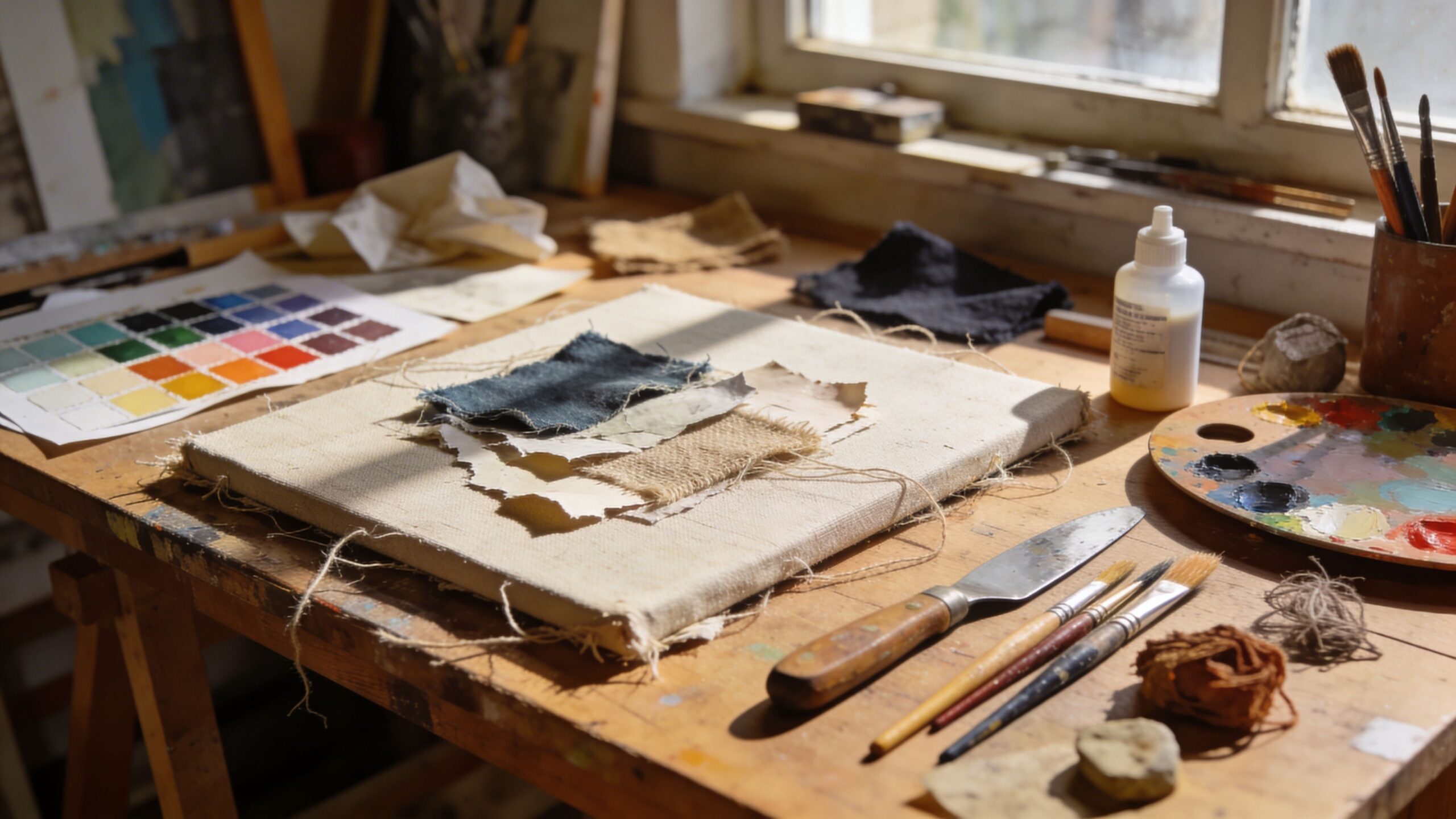
Mixed media can look wildly different from artist to artist, but most pieces are built from a few foundational elements: a surface, an adhesive or binder, and layered materials. The surface might be canvas, wood panel, paper, cardboard, or even fabric stretched tight. The binder is often glue, gel medium, or paste—something that helps layers stick and hold up over time.
From there, the magic is in the layering. Mixed media typically combines “flat” materials, like paper and paint, with “dimensional” materials, like textured paste, thread, thin wood, or small found objects. Even a subtle raised surface changes how light moves across the piece, which instantly adds depth.
Because mixed media can become complex quickly, beginners often do best by focusing on one idea at a time. Start with a simple surface, try two or three materials, and build slowly. Once you understand how your materials behave, you can expand your toolkit.
Surfaces You Can Build On
Choosing a surface is like choosing a stage for your materials. Each surface has its own strengths. Canvas is lightweight and familiar, but heavy collage layers can cause warping if it isn’t supported well. Wood panels are sturdy and ideal for thick layers and heavier objects. Mixed media paper is designed to handle wet media without buckling too much, making it a reliable choice for painting and collage together.
Cardboard is a beginner’s secret weapon because it’s cheap, easy to cut, and surprisingly versatile. It can warp if soaked, but it’s excellent for dry layers and light adhesives. Fabric surfaces are also exciting, especially for textile-heavy mixed media, because they already contain texture and softness.
If you’re unsure, a primed wood panel is one of the easiest starting points for durable mixed media. It holds texture well, it stays flat, and it feels stable under your hands.
Materials That Work Beautifully Together
Mixed media materials fall into a few broad families. Paints, like acrylic, are common because they dry quickly and layer well. Papers are another major category, including torn book pages, craft paper, tissue paper, handmade paper, and printed images. Textiles bring softness and structure through fabric scraps, lace, thread, yarn, and stitched elements.
You can also introduce “earthy” textures like sand, dried leaves, bark, or small stones. Found objects add narrative and surprise, but they should be used thoughtfully. A single meaningful object is often stronger than a handful of random items.
Finally, texture mediums—like modeling paste, gesso, and gel medium—are what make mixed media feel sculptural. They let you build ridges, cracks, raised shapes, and subtle dimensional effects that paint alone can’t create.
The Most Useful Adhesives and Mediums
Adhesives are the quiet heroes of mixed media. If layers don’t stick well, the artwork won’t last. Basic white glue works for many paper layers, but it can wrinkle thin paper and can become brittle if used too heavily. Glue sticks are convenient but not always strong enough for long-term durability.
Many mixed media artists prefer gel medium because it acts as both adhesive and sealant. It can be brushed under paper to stick it down and brushed over the top to protect it. It also dries clear, which helps maintain the look of your layers. Paste-like adhesives are useful for heavier collage elements because they fill gaps and grip quickly.
If you’re mixing wet paint and paper layers, a reliable medium makes the process smoother. It reduces bubbling, helps prevent peeling, and creates a cohesive surface that feels intentional rather than patched together.
Layering Techniques That Create Depth
Layering is where mixed media becomes its own language. The simplest layering method is collage: adhering paper to a surface, then painting over it, around it, or through it. But mixed media layering can also involve sanding, scraping, tearing, and reworking. You can paint a layer, cover it, distress it, then reveal parts of it again. This creates history in the artwork, as if the piece has lived through time.
Transparency is another powerful layering technique. Tissue paper, thin paint washes, and glazing effects let earlier layers show through. This gives the artwork a sense of depth that feels atmospheric. Opaque layers, on the other hand, provide bold contrast and clear focal points. The strongest mixed media pieces often use both: transparent layers for atmosphere and opaque layers for structure.
Texture layering adds literal depth. Modeling paste can be applied smoothly for subtle relief or built up for dramatic effects. When you paint over raised texture, the high points catch light and the shadows deepen, making the artwork feel dimensional even from across a room.
Mark-Making: The Signature of Your Style
Mark-making is the set of gestures you add to a piece: brush strokes, scribbles, stamps, scratches, and patterns. These marks often become the “voice” of your mixed media style, because they are uniquely yours. Two artists can use the same materials and create completely different results based on how they move their hands.
Beginners often feel pressure to create “pretty” marks, but mixed media thrives on variety. Rough marks can be powerful. Scratches can create energy. Drips can create motion. Even a simple repeated line pattern can give rhythm to a surface.
Mark-making also helps unify layers. A piece with lots of different papers and textures can feel chaotic until you add repeated marks that tie everything together. Think of marks as the stitching that holds the visual story in place.
Composition: Where to Place the Story
Composition in mixed media is about guiding the viewer’s eye through a busy surface. Because mixed media can contain many elements, composition matters even more than in a simple painting. A successful piece usually has a clear focal point, supporting areas, and some breathing room.
Contrast creates focus. A bright area against muted layers draws attention. A sharp edge against soft textures creates interest. A cluster of details against a quiet background gives the eye a place to land. If everything is equally loud, the viewer doesn’t know where to look.
A practical approach is to build your background layers first, then pause and decide what the artwork needs. Does it need a strong central shape? A diagonal movement? A calmer area? Mixed media is forgiving because you can adjust composition late in the process by adding or subtracting layers.
Color Strategies That Keep It Cohesive
Color can quickly make mixed media feel either harmonious or messy. One easy strategy is a limited palette. When you restrict yourself to a few colors, the varied materials still feel connected. Neutrals are especially effective in mixed media because they let texture become the star.
Another approach is to use color temperature. Warm colors can create energy and closeness, while cool colors create calm and distance. You can use warm accents to draw focus and cool tones to create background atmosphere.
You can also unify color by glazing. A thin wash of color over multiple layers can “pull” them together visually. Even if the layers underneath differ in pattern and texture, a consistent glaze can make them feel part of the same world.
Mixed Media Ideas to Try Right Away
The best beginner ideas are simple, structured, and flexible. A layered abstract canvas is a classic starting point: begin with painted underlayers, add torn paper, introduce texture paste, and finish with marks and highlights. This approach teaches you the basics of layering without requiring detailed drawing skills.
Another beginner-friendly project is a mixed media “memory piece,” where you choose a theme—like travel, nature, or music—and build layers that reflect that idea through color and materials. The goal is not literal illustration, but mood and symbolism.
A third strong idea is a texture study. Pick a neutral palette and focus on building surface variety using different papers, pastes, and fabrics. This project builds confidence in material handling and shows you how powerful texture can be even without bold color.
How to Avoid Common Mixed Media Frustrations
Mixed media has a few predictable beginner challenges. Wrinkled paper often happens when too much glue is used or when paper is too thin. Working from the center outward and using a smoother tool can help reduce wrinkles. Warping surfaces often happen when wet layers soak into paper or cardboard. Choosing a sturdier surface or working in thinner layers helps.
Another common issue is overworking. Mixed media is so fun to build that it’s easy to keep adding until the piece loses clarity. A helpful habit is to pause often and evaluate what the artwork needs. Sometimes it needs one bold shape, not five extra layers. Sometimes it needs contrast, not more texture.
Finally, beginners sometimes feel unsure about “finishing.” Mixed media pieces often feel finished when the focal point is clear, the composition feels balanced, and the surface has both quiet and detailed areas. If you keep changing the piece without improving it, it may already be done.
Sealing and Protecting Finished Work
Because mixed media uses multiple materials, finishing steps matter. Many artists seal the surface with a clear medium to help protect layers and reduce fragile edges. Sealing can also unify the sheen across different materials, which helps the artwork look cohesive.
If your piece includes fragile collage edges or delicate fibers, sealing helps prevent peeling and damage over time. It also makes the piece easier to dust and handle. The key is using a finish that works with your materials and applying it in thin, even layers so it doesn’t cloud or distort textures.
How Mixed Media Helps You Find Your Artistic Voice
Mixed media is not just a technique; it’s a way of thinking. It encourages experimentation, welcomes imperfection, and rewards personal choices. Because it combines materials, it naturally becomes personal. You choose what to include, what to cover, what to reveal, and what to emphasize. Those choices become your style.
Over time, you may discover you love paper-heavy collage, or you may lean toward sculptural texture. You might be drawn to bold color, or you might prefer muted tones with strong surface detail. Mixed media gives you room to explore until you find what feels like you.
The most exciting part is that mixed media grows with you. As your skills expand, your materials expand. As your ideas deepen, your layering becomes more intentional. And as you keep creating, you start to recognize your own visual fingerprints in every piece.
Your Next Step: Start Simple, Then Build Big
If you’re new to mixed media, start with a small surface and a simple plan. Choose two or three materials, build a background, add a focal point, then finish with marks and highlights. The goal is not to make a masterpiece on the first try. The goal is to learn how materials behave, how layers interact, and how your creative instincts guide the process.
Mixed media art is one of the most flexible and rewarding ways to create. It turns ordinary materials into rich, dimensional artwork that feels alive with texture and story. Once you begin, you’ll start seeing artistic possibilities in everything around you—and that’s when mixed media truly becomes more than a technique. It becomes a creative habit.